
India’s Employment Paradox: Low Unemployment, High Vulnerability

--
Why job quality, skill mismatch, and policy design are at the heart of India’s labour
challenge
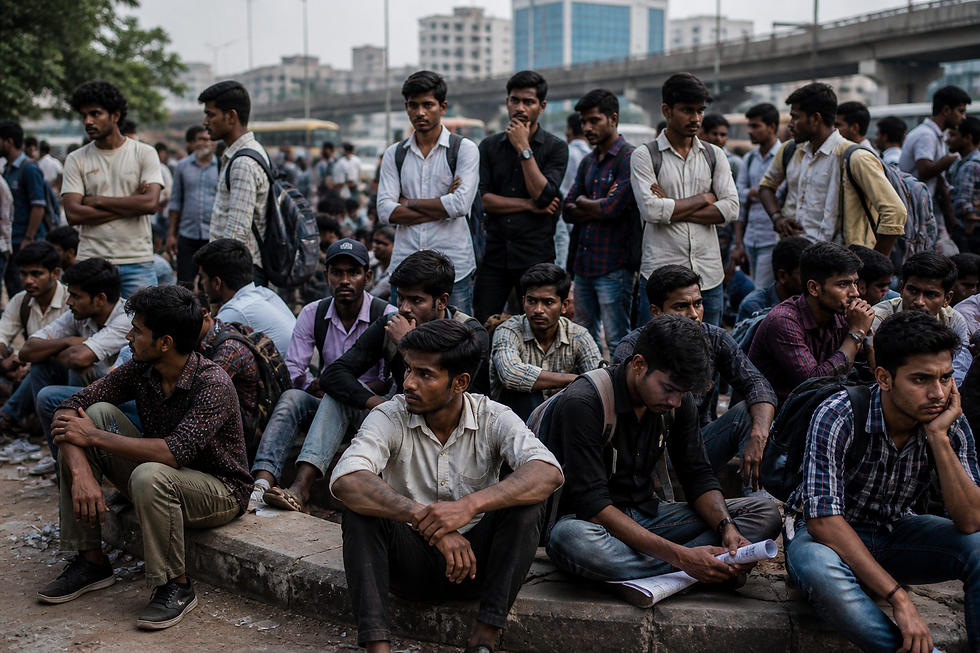
India’s labour market presents a paradox. Headline data from PLFS 2025 shows unemployment at 3.1 percent, with youth unemployment at 9.9 percent. Yet beneath these numbers lies a more fragile reality—marked by underemployment, job insecurity, and a widening mismatch between education and employment.
Labour force participation remains around 59 percent, and current weekly status unemployment is closer to 5–5.6 percent, pointing to volatility in job availability. More importantly, the nature of employment raises concern: over 54 percent of the workforce is self-employed, while only about a quarter is in regular salaried roles. Much of India’s workforce remains trapped in low-productivity, low-income activity.
The State of Working India 2026 highlights the scale of the challenge. Nearly 40 percent of graduates under 25 are unemployed, and unemployment among those aged 25–29 remains near 20 percent. Of the 6.3 crore graduates in this cohort, about 1.1 crore are unemployed. The issue is not lack of education—it is lack of employable opportunities.
Recent recruitment patterns offer a striking signal. In Rajasthan’s 2025 peon recruitment, over 24 lakh candidates—including PhDs, MBAs, and lawyers—applied for roles requiring only a Class 10 qualification. Similarly, police constable recruitment in Madhya Pradesh saw PhD holders and thousands of engineering graduates competing for entry-level positions. These trends reflect a deeper shift: when highly educated individuals seek low-skill, secure jobs, it signals a breakdown in job matching and declining returns to education.
Policy responses over the past decade have been extensive. Skill India and PMKVY have trained over 1.4 crore individuals, yet placement rates often remain between 20–35 percent. Apprenticeship programmes have expanded but still fall short of global benchmarks. MGNREGA continues to support rural incomes but does not create pathways to formal employment. PLI schemes have attracted large investments, though job creation has been slower and more capital-intensive than expected. The recently introduced Employment Linked Incentive scheme may support formalisation, but its ability to generate additional employment remains uncertain.
At the same time, the rapid expansion of the gig economy—now employing over a crore workers—has improved access to work but introduced new vulnerabilities around income stability and social security.
An increasingly debated factor is the rise of welfare transfers or “freebies.” At the margin, such support can raise reservation wages, making workers less inclined to accept low-quality jobs. However, this is not the primary driver of the employment challenge. The deeper concern is fiscal and structural: sustained subsidy spending of 2–3 percent of GSDP may crowd out investments that generate productive employment. The policy imperative is to distinguish between consumption support and capability-building investments that enhance employability.
The core problem lies in a structural disconnect. Employment initiatives remain heavily supply-driven, while job creation depends on demand conditions in labour-intensive sectors. Policy efforts are fragmented across skilling, industry, and labour systems, limiting their effectiveness. Above all, informality continues to dominate, with over 80 percent of workers outside formal employment frameworks.
India’s employment challenge now requires a shift—from programme scale to system alignment. Skilling must be linked to local industry demand. Apprenticeships should become mainstream entry pathways. Labour-intensive sectors must be prioritised for growth. Formalisation needs to be incentivised through simplification, not just compliance. And welfare policy must increasingly focus on building human capability rather than sustaining dependency.
India’s employment paradox is not a failure of intent—it is a failure of alignment. The rise of overqualified applicants for low-skilled jobs, alongside expanding but insecure forms of work, highlights a deeper imbalance. The real challenge is not just to create jobs, but to create work that is productive, secure, and aligned with the aspirations of a rapidly evolving workforce.
Trust us to get your leaders to be at their best!


Comments