
Built to Hold: Leading Enterprises in the Structural Decade

--

An architecture for Boards and CEOs when the operating environment refuses to settle.
The diagnosis of the structural decade is by now widely shared: three categories of risk have moved from episodic shocks to defining features of the operating environment, and they converge on a single enterprise in a single quarter. The architecture for responding to them is far less settled. This perspective is an attempt at that architecture.
On a single day in April 2026, the world’s fifty hottest cities were all in India. Earlier in the same quarter, the Iran conflict disrupted oil flows through the Strait of Hormuz, on top of the now-chronic dislocations from Russia-Ukraine and Red Sea shipping. Capital markets repriced energy security overnight. AI capability advanced faster than the planning cycles built around it. State-actor cyber threats against critical infrastructure reached levels national cybersecurity agencies have publicly flagged. This is the structural decade, arriving.
These are not three independent stories. They are three pressure systems converging on a single enterprise, in a single quarter, on a single CEO’s desk. They amplify each other. A heat-stressed workforce, a fuel supply disruption, and a cyber breach hitting operational systems. A capital market simultaneously pricing physical risk, geopolitical risk, and technology risk on the same longduration assets. A Board having to make three high-stakes calls in a single quarter, on three different timescales, with overlapping information needs.
For Boards and CEOs everywhere, this poses a question the existing playbook cannot answer: how does one build an enterprise that remains sustainable over the next decade and beyond, when the operating environment refuses to settle?
The framework that follows develops in seven sequenced moves. It begins with vision, and with the recognition that vision in this decade has to do something different from what it did in the last one. Part 1, this article, develops the first six moves. Part 2, next month, takes up the seventh.
Vision Must Move From Prediction to Preparation
The corporate vision that shaped most enterprises through the long stability period rested on three confident assumptions: a stable physical environment, a stable geopolitical and regulatory environment, and a stable technology and security environment.
The vision, strictly, is the picture the enterprise has of its own destination. What has to move now is the vision together with the discipline of foresight underneath it: the assumptions about the world inside which the destination will be pursued.
All three assumptions are now increasingly unreliable. But the deeper diagnosis is more uncomfortable than the answers being wrong. The confidence with which we held them was wrong. Confidence in any assumption sits on a sliding scale. At one end is what we know: verified, tested, durable, the kind of claim that survives contact with reality. In the middle is what we think we know: believed on the balance of evidence, defensible but unproven, subject to revision when new data arrives. At the other end is what we don’t know: the genuinely uncertain, the off-script, the fragmented signals whose pattern only emerges with time. Honest leadership in the next decade requires being ruthless about where any given assumption actually sits on that scale, and treating each appropriately. The discipline that replaces prediction is calibrated foresight, not better forecasting.

The earlier vision treated almost every assumption about the operating environment as if it sat at the what we know end of the scale. The Strait of Hormuz would stay open. The monsoon would arrive on time. The cloud would be defensible. AI would evolve at the pace of the previous decade. None of those were known; most were, on honest reflection, only believed; and a few were close to genuinely unknown. Current reality has not validated those confidences.
The Teesta III dam disaster in Sikkim is what assumption-without-calibration looks like in practice. A 1,200 MW hydroelectric project worth ₹14,000 crore was destroyed in October 2023 by a glacial lake outburst flood from South Lhonak Lake. Climate scientists had been warning about glacial-lake vulnerability in the region for over two decades. The project was built and operated on a confidence about a stable physical environment. The asset was destroyed. The capital was destroyed. Lives downstream were lost. The risk had a name.
For three decades, CEOs across major economies designed enterprises for predictability. Five-year strategic plans. Steady-state operating models. Linear capacity expansion. The discipline was prediction: better forecasts, tighter variance management, more granular planning. That discipline still has its place. But the more important discipline for the next decade is preparation, for the unexpected, the off-script, and the events that combine opportunity with risk. Next year may not look like this year. It could be a year of opportunity (AI-driven productivity, energy-transition acceleration, post-conflict capital flows) or of risk (further geopolitical escalation, climate extreme, cyber breach, AI misdeployment). Most likely both, simultaneously.
The vision shift required is from extractive growth to resilient growth. Shareholder-returns primacy gives way to multi-stakeholder durability. Efficiency-optimised supply chains become risk-stratified ones. Quarterly capitalmarkets storytelling makes room for long-horizon enterprise value protection.
Ørsted, the case study that follows, has been taught by the author across multiple CXO cohorts over the last five years, and the lessons it has yielded now sit inside this framework.

Materiality Is the Discipline of Focus
Before vision translates into imperatives, leadership must answer one question: of all the risks in the universe (geopolitical, ESG, cyber and AI), which actually move enterprise value? Materiality is the discipline of answering that question honestly. A matrix forces it along two axes. Financial materiality measures direct impact on enterprise value, P&L, cash flow, asset values, and cost of capital. Stakeholder materiality measures importance to investors, regulators, employees, customers, communities, and value-chain partners.
What has changed in the last eighteen months is that the top-right quadrant of that matrix is more crowded than ever before. Climate transition, cyber resilience, and AI strategy and model risk have all migrated up and to the right, joining the long-standing items that demand Board and CEO attention. And the cost of getting any one of them wrong has risen. A single cyber incident, a single stranded-asset write-down, or a single AI deployment that misfires can move enterprise value materially in days.
The three risks named at the opening of this perspective are material for almost every enterprise in almost every sector right now. They are not the only material forces in motion. Generational shifts in consumer behaviour, AI-mediated reshaping of talent markets, demographic transitions, and regulatory stepchanges in specific industries: each can be the most material force on a given Board’s agenda. The framework does not specify which forces matter. The materiality discipline does. The framework is built to absorb whichever forces emerge as material. This framework is not about ESG reporting. It is about enterprise durability under structural instability.
For Boards, the practical implication is straightforward: if the materiality matrix has not been revisited in the last twelve months, it is likely out of date.
From Materiality to Enterprise Value
The crowding of risks in the top-right quadrant brings a new imperative: enterprise value protection and creation.
Most senior leaders are trained to speak the language of value creation: growth, margin expansion, capital efficiency, the offensive playbook of running an enterprise. Far fewer are trained to speak the language of value protection. Both now matter equally. A climate transition programme creates value when it opens new revenue lines and protects value when it lowers the cost of capital. An AI capability investment creates value when it generates productivity and protects value when it reduces operational risk. An enterprise that knows what is material but cannot translate it into the twin objectives of protection and creation will see its stakeholders translate it for them, usually unfavourably, and usually late.
Resilience Enables Agility
Enterprise value protection and creation are not separate disciplines. They are two faces of the same enterprise. The operating posture that delivers both is the paired discipline of resilience and agility, taken as a sequence rather than as alternatives.
Resilience is the capacity to absorb shocks without breaking: the buffer of cash, the redundancy of supply chain, the depth of leadership bench, the optionality of contracts. Resilience keeps an enterprise in the game when things go wrong. It is the primary engine of value protection.
Agility is the capacity to move quickly when the environment shifts: the speed of decision, the readiness to pivot, the willingness to abandon a plan when reality has changed. Agility lets an enterprise capture opportunity when things go right, and contain damage when they go wrong. It is the primary engine of value creation in conditions of unpredictability.
Resilience is the precondition that enables agility. The CEO who optimises only for resilience builds a bunker that is safe but immobile. The CEO who chases only agility builds a sprinter that is fast but fragile to any sustained shock. The leader the decade calls for builds both, in that order.

This work has real costs. Resilience-grade supply chains carry inventory that pure-efficiency models do not. Long-horizon investments depress near-term returns. Stakeholder durability sometimes runs against activist investors. The framework does not pretend these tensions away. Boards that take it seriously will commit to absorbing them, because the cost of not absorbing them is higher in the decade ahead.
Ørsted, the case study earlier in this perspective, is the canonical example of a CEO absorbing these trade-offs successfully. Anders Eldrup shut down profitable coal projects, took a controversial Goldman Sachs equity injection, and ran the cost of the pivot for nearly a decade before the wind thesis was proven in capital markets. The bet paid. The framework’s call to lead through trade-offs is not a guarantee that the call succeeds. Emmanuel Faber lost his position as CEO of Danone in March 2021, after activist investors judged that his stakeholder capitalism agenda, including Danone’s adoption of the Entreprise à Mission legal form, had come at the cost of shareholder returns relative to peers. Two pivots, two different outcomes. The framework does not promise that the trade-offs always resolve in the leader’s favour. It says that the alternative, leaving the trade-offs unmade, is structurally worse.
Five Imperatives for the CEO
A redrawn vision, a disciplined materiality lens, a clear language of enterprise value protection and creation, and the paired postures of resilience and agility together ask five things of the CEO, personally, and across the risk universes.
1. Own the integrated narrative.
Compartmentalisation, where geopolitics goes to the risk committee, climate to sustainability, and cyber and AI to the CTO, is the fastest way to lose. The CEO must speak one language across all three: the language of enterprise value protection and creation introduced earlier in this article. All three show up in the financial picture, and they belong in one integrated view, not in three separate functional reports. The integrated narrative is the deal.
2. Hold multiple horizons simultaneously.
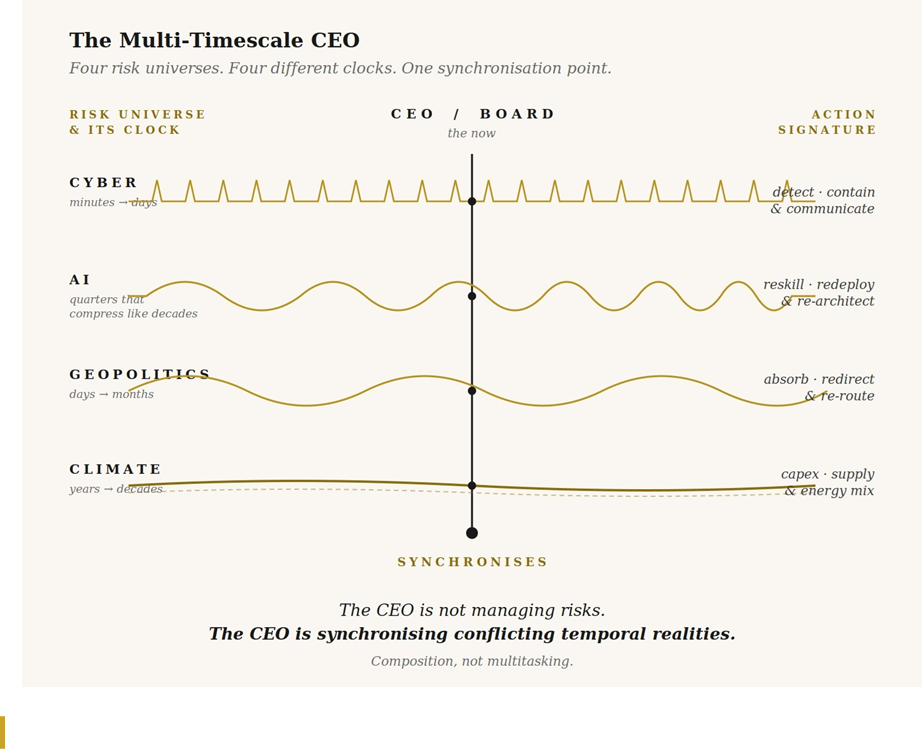
Each risk universe runs on a different clock. Cyber operates in minutes to days: detect, contain, communicate. Geopolitical runs in days to months: absorb the disruption, redirect the flow. AI moves in quarters that compress like decades, where a capability gap of eighteen months can become structural. Climate plays out across years to decades, with capex specified for higher-temperature operating envelopes, supply chains stratified, and fossil exposure restructured. The CEO must hold all four time signatures in the same head. This is not multitasking. It is composition.
3. Drive business model evolution.
Most major corporate pivots of the last three decades were opportunistic. The next decade’s pivots will be necessary first, opportunistic second. The same conviction Ørsted showed in fossils now confronts steel, cement, oil and gas, autos, shipping, and financial services in every major economy. Layered on top of all of these is an AI dimension (productivity, product, distribution, decision support) that will reshape unit economics in every sector in the short to medium term. Boards that wait for the case to be obvious will pay the retrofit premium that earlier movers have already collected.
The CEO needs to ask one question. In 2030, will my P&L mix, supply-chain footprint, energy mix, and AI-enabled capability look meaningfully different from 2026? If the answer is no, the pivot has not started.
4. Build stakeholder coalitions.
A redrawn vision cannot be delivered alone. Six categories of relationships have to move from transactional to deliberate: workforce, capital providers, supplychain and technology partners, regulators, communities and governments, and peer enterprises. Three principles run across all six. Pre-built: each relationship built before the shock makes you need it, on terms that survive a bad year rather than a good quarter. Diversified: across each axis, so that no single relationship is load-bearing. Intelligible: each counterparty understands what the enterprise actually does, well enough to back it when it matters. Concentration in any one of the six is the single largest source of structural fragility, and the one most CEOs underweight until a disruption forces it onto the agenda.
5. Model personal resilience and learning.
Crises define leaders, and the next decade is a compound crisis spread across ten years. The CEO who leads visibly through bad quarters, through investor scepticism, through political headwinds, and through their own ongoing learning sets the tone for the enterprise. The leaders most likely to emerge well from this decade will be the ones who chose to stay students.
Five Enablers That Make the Imperatives Work
Imperatives without enablers are aspirations. Five enablers determine whether the imperatives translate into outcomes, and whether the enterprise has the resilience that lets it act with agility.
1. Capital architecture for compound risk.
The enterprise needs financing terms that survive a structural decade, not just a good year. Three principles. Patient capital, sized to the long horizon and on terms that hold through a bad quarter; the right instrument differs by enterprise, the discipline does not. Strip the labels. A useful Board test for any compound-risk pitch is whether the same investor would fund it if every label (ESG, sustainability, digital transformation) were stripped, and the proposition were described purely as risk management and enterprise value protection. And capital mapped to risk: green instruments to climate capex, hedges to geopolitical exposure, cyber and AI investment as core capex.
2. Governance refresh.
The Board has to be competent in the three risk universes and incentivised to take them seriously. Three moves. First, structural-risk competency at the Board, by 2028: a climate-fluent director, a geopolitical- or security-fluent director, and a cyber- and AI-fluent director, as competencies rather than necessarily three new appointments. Second, risk-committee scope expanded to name physical climate risk, geopolitical scenario risk, and cyber and AI risk explicitly, rather than absorbing them into a generic “external risk” bucket. Third, executive compensation linked to multi-year resilience and agility outcomes, not only to annual operating performance.
3. Information infrastructure for unpredictability.
The executive team needs the three risk universes visible alongside operating performance, on a cadence that matches each universe’s clock. Three principles. Integration: the risk view sits inside the operating review, not in a parallel report. Visibility: a small set of leading indicators that the CEO and CFO can name from memory. Long dashboards rarely get read. Cadence-matching: refresh frequency tuned to each risk’s actual speed, not to a calendar convenience.
4. Practised response.
Plans on the shelf do not run. Crisis playbooks for cyber breach, supply disruption, climate event, and AI failure modes have to be exercised, not written. A quarterly tabletop simulation with the executive team. An annual full-scale drill. Pre-mortems on every major capital commitment. The enterprises that act decisively when a shock arrives are the ones that have practised. The enterprises that freeze are the ones whose first real rehearsal was the actual event.
5. Talent and learning systems.
Heat- and climate-resilient workforce strategies in exposed geographies. AI reskilling at scale across the enterprise. Cyber awareness embedded in every function. Enterprises that build the muscle to absorb new capability quickly are the ones that stay agile. Talent, not capital, is the binding constraint in this decade for most enterprises in most economies.
A Framework Built to Hold the Decade
There is no single crisis here. There is a new operating reality, in which periods of stability are shorter and harder to predict than they used to be. The Boards and CEOs who define the next decade will be the ones who let that reality rewrite their vision, and then translate the rewrite into materiality discipline, into a clear language of enterprise value protection and creation, into the paired postures of resilience and agility, into specific imperatives owned at the top, and into enablers built into the bones of the enterprise. Underneath all of this sits a deeper layer: the leadership mindsets that hold the framework together. Those mindsets are the subject of Part 2 of this perspective, which follows next month.
The unpredictable world is here. The question is whether to lead with a framework that can hold it.
Sustainable, in this decade, means the capacity of the enterprise to endure, to absorb, and to move repeatedly, through whichever combination of shocks the environment delivers.

And One Last Question
All of the above (vision, materiality, posture, imperatives, enablers) is the how of leadership in an unpredictable world.
Beneath it sits a why that no framework can substitute for. Every Board that does the work this article asks of it will eventually arrive at the same question, the one that the redrawing of everything else has been quietly approaching all along:
does our purpose still hold?
Vision says where the enterprise is going. Strategy says how it will get there. Purpose says why any of it matters: to customers, employees, investors, communities, and to the people who run the company. In stable environments, purpose can be left implicit. The water does not need to be examined as long as it is calm. In environments like the one we are now in, the water has to be examined.
As the vision is redrawn for the unpredictable decade, every Board has one of two responsibilities. Reaffirm the existing purpose, explicitly, deliberately, with the recognition that it remains the right answer in a changed environment, and with the visible work of relinking it to the redrawn vision. The strongest cases of reaffirmation are purposes drawn deeply enough that the environment can change around them without obsoleting them. Tata Group is the clearest example: Jamsetji Tata’s founding statement that community is the very reason the enterprise exists has held through nearly 160 years, across every conceivable transition in technology, geography, and ownership. The group’s stated ethos, “Leadership with Trust,” is the operating expression of that founding purpose. Trust is the durable outcome of a purpose that has stayed clear. The alternative is to redraw, because the environment has changed enough that the original answer no longer holds. Both outcomes are legitimate. What is not legitimate is leaving the question unasked while everything around it is being rewritten.
Three diagnostic questions help Boards know which they are facing. Does the purpose statement, read aloud today, still describe a company that exists? Does it survive translation into the compound risks now reshaping the operating environment? Does it give the CEO a clear answer to “when we have to choose between two things our shareholders want, which one wins?” If the answers are no, purpose needs to be redrawn alongside the vision. If they are yes, and especially if they have been yes for decades, purpose needs to be reaffirmed, visibly, with weight, in the language of the present moment.
Reaffirmation is not a small act. A Board that publicly restates purpose at a moment of structural change, and links it deliberately to the redrawn vision, to capital allocation, and to executive compensation, is doing the foundational leadership work of the decade. It tells employees, investors, and customers that the chaos outside has not unsettled the why inside. It is the one signal that holds when every other signal is moving.
The framework will tell you what to do. Purpose will tell you why it matters. The leaders who hold the decade will be the ones who answered both questions, in that order, with deliberation, and with the courage to redraw whichever one no longer holds, or the conviction to reaffirm whichever one still does.
The framework, in practice, becomes an agenda. What follows is what that agenda looks like.

How Crossmentors Can Help
This is the work Crossmentors is built to support. We are a collective of senior CXOs who have led through structural change in financial services, industrials, energy, technology and consumer sectors, in mature and emerging markets. We work alongside Boards and executive leader
ship teams to translate frameworks like the one above into agendas, action lists into outcomes, and the harder conversations into shared clarity.
If any of these actions would benefit from outside facilitation or counsel, or if a conversation about where to start would help, we are happy to help. Reach out.
Trust us to get your leaders to be at their best!


Comments