
The Being Gap

As AI takes over Knowing and Doing, Being is the only edge for leaders.
-

-
Every retail collapse of the past two decades was preceded by a failure no spreadsheet recorded. The assets were solid, the strategy credible, the leadership pipeline strong. What broke first was culture, and in the age of AI agents that failure turns fatal. This article looks at eighteen retailers to show where it hides, and what leaders can do about it. |
On 28 March 2007, Circuit City let go of 3,400 of its most experienced store associates. Not because they performed badly. Because they were paid too much.
The decision had been modeled in spreadsheets and approved at the top. CEO Phil Schoonover had the numbers, and he knew the company’s service model rested on experienced people. On paper, it was disciplined cost management.
Customers felt it within weeks. Nobody read the press release; they simply walked in and sensed that something had changed. Eighteen months later Circuit City filed for bankruptcy, with more than $10 billion in annual revenue gone. His predecessor, W. Alan McCollough, later reflected: “We knew what was coming. We just didn’t change fast enough.” I don’t think speed was the problem. In my case study, leadership failure came first and produced every strategic misstep that followed. Circuit City did not lose to Amazon or Best Buy. It lost its own culture first, and no spreadsheet caught it happening.
Circuit City is a template, not an anomaly. Across more than 50 retail case studies over two decades, I keep finding the same story at Sears, Toys R Us, J.C. Penney, Borders, and Victoria’s Secret. None of them collapsed due to ignorance or poor strategy. One dimension of leadership was allowed to weaken until the market punished it, without warning. And it was almost always the same dimension.
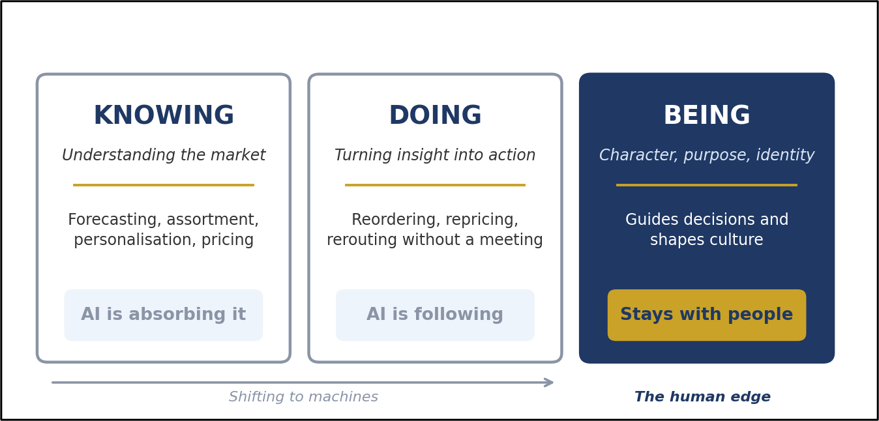
Now add AI to that picture. Knowing has already shifted. Forecasting, assortment, pricing, and personalization, the work that once filled a room with analysts, is done by models in seconds, and anyone can rent the same models. Agents are arriving next. They will not just recommend what to reorder, reprice, or reroute. They will do it, and with it many of the jobs we have always called management. Knowing and Doing are both moving to machines.
That leaves leaders with one real edge: Being, the inner core of leadership. It is the character, purpose and identity that guide decisions and shape culture, and so decide how all that machine intelligence gets used. Three scholars, Nitin Nohria, Rakesh Khurana and Scott Snook, describe leadership as Knowing, Doing and Being. Across my cases it is always Being that breaks first. Boards never measure it. Succession plans never develop it. Annual reports never mention it. I call it the Being Gap, and in the AI era it decides who survives. No model can supply it, and no competitor can copy it.
What Is Left When AI Knows and Does
For years, a weak culture was costly but survivable. A retailer could cover for it with sharp analysts and fast operators. AI is taking that cover away.
Retail is where this is happening fastest. Demand forecasting, assortment planning, personalization, and dynamic pricing are already absorbed by AI, and agents are taking on the execution that follows. Knowing the dimension that business schools have always overemphasized, and retailers have always recruited for, is a commodity. Doing is next.
Walmart shows what the next looks like. A senior executive in its supply chain technology team has described AI that adjusts replenishment schedules when demand surges faster than forecast, and that, in distribution centers, predicts equipment alerts, recommends next steps, and, in many cases, carries them out. It has also given its merchants an AI agent called Wally. Not long ago, those were management jobs.
“AI is commoditizing knowing faster in retail than almost anywhere else. What cannot be automated, copied, or contracted out is who your leaders are and what your culture stands for. That is the new moat.” — Srikant Gokhale
The risk is not that leaders become irrelevant. It is that they pour everything into Doing and neglect Being, and end up with an organisation that is data-rich and purpose-poor, fast and hollow. Amazon and Costco show what AI does when it amplifies a strong culture. For a retailer without one, AI simply speeds up the road it was already on.
Knowing, Doing, Being
The framework from Nohria, Khurana, and Snook is simple. Knowing: understanding one’s environment and making informed judgments. Doing: translating insight into action and converting strategy into outcomes. Being: the inner core of leadership, the character, purpose and identity that guide decisions and shape culture.
Of the three, Being is the one leadership education has neglected most, even though it is the foundation the other two stand on. Without it, competence has no direction and execution turns dangerous. I have applied this framework to retail, and the finding is consistent: when a retailer fails, Being goes first, and the other two follow.
Why Retail Feels It First
I have stood in enough retail boardrooms, in enough markets, to know these are not theoretical points. Three things make retail the canary in the leadership mine.
One associate away. In retail, the distance between a leader’s character and a customer’s experience is a single associate handling a single interaction. When Circuit City dismissed its most experienced staff, customers felt it within weeks. There was no earnings-call delay and nowhere to hide.
The deadliest gap between Knowing and Doing. Circuit City knew Amazon was coming. Sears had data forecasting Walmart’s rise. Borders saw the digital shift years before it acted. None of them lacked insight. They lacked the ability to turn it into action at the speed the market demanded.
No room for imbalance. The retail middle is vanishing. In 2024, 37 shops closed every day in the UK, and 15,000 closures are projected in the US for 2025. Mid-tier chains are not dying from one catastrophic mistake. They are simply not excellent enough across all three dimensions.
The same logic holds in hospitality, financial services, and healthcare, anywhere the distance between leadership and customer is short. Retail is just where the Being Gap is punished first.
Eighteen Retailers, One Pattern
Is this a pattern, or just a handful of memorable failures? To find out, I reviewed the corporate communications of eighteen retailers from my case research: thriving, transitioning, and failed, across the US, UK, and Europe. I read annual reports, SEC filings, CEO letters, and investor-day transcripts, and rated how prominently each spoke about Knowing, Doing, and Being. The ratings are my own and cross-checked against earlier casework. The figures I cite come from company filings.
The six thriving retailers all build Being into the structure. Amazon governs every hire and performance decision through 16 Leadership Principles. Inditex logs 3.3 million training hours and fills 70% of vacancies internally. Costco renews 90.5% of its members worldwide and pays US staff about $31 an hour. All six of IKEA’s CEOs have been internal appointments. Walmart was led by a 30-year associate, Doug McMillon, and Home Depot’s Ted Decker came up through seven internal promotions over 24 years.

The other end is just as clear. Sears, Circuit City and Toys R Us, the three that went bankrupt, show no culture or values language in their final public communications. Their filings were about financial engineering, expansion and cost targets, or debt service. Nowhere do those leaders ask who the organisation was becoming, only what it needed to cut.
In between sit the retailers at risk. Starbucks let operational metrics crowd out Being in its 2017 to 2022 filings, until Howard Schultz returned and said the company had ‘lost its soul.’ Gap Inc.’s 2024 annual report admits it is ‘not where it needs to be’ on culture. J.C. Penney imported a personal Being from Apple that had no roots in its own culture, and the organisation rejected it quickly.
A word on what this analysis can and cannot show. It reads what companies say about themselves, so it measures how prominently a retailer talks about culture, not the culture itself. Some companies speak warmly about values and deliver little, and some strong cultures say almost nothing to investors. I rated these companies knowing how their stories ended, and the ratings are mine alone, so hindsight may have crept in. Eighteen retailers from my own research are enough to show a pattern worth taking seriously, but not to prove cause. Debt and real estate strategy mattered at Sears and Toys R Us too. What I can say is that the pattern was consistent across all eighteen, and that it matches what I saw leading retail organizations. Treat it as a strong hypothesis, and test it in your own organization.
This is unlikely to be a coincidence. The language a retailer uses with its investors hints at what it measures, rewards, and develops. When Being disappears from the language, it has often already disappeared from the pipeline.
Three Stories from the Shop Floor
The numbers show the pattern. The stories show how it feels from inside.
1.Knowing: curiosity beats expertise
Knowing in retail is not analytical competence. It is anticipation. The difference between reading a consumer shift at its peak and reading it six months earlier is not intelligence. It is the quality of curiosity. Circuit City’s buyers knew electronics cold. What the organisation never demanded was the habit of asking: what do we believe that is about to be wrong?
M&S shows the cost. In the early 2010s its leaders were some of Europe’s most seasoned merchants, but that mastery had become their identity, and questioning the buying model felt like questioning themselves. ASOS and Boohoo turned new styles in weeks while M&S kept long lead times and seasonal drops. A former executive told the Financial Times: “We had all the knowledge in the world. We just didn’t have the curiosity to question it.” Inditex does the opposite. Its leaders are trained to treat all knowledge as provisional and every advantage as temporary. The principle is simple: ‘Observe more than you assume.’
2.Doing: speed needs permission
Doing is not execution discipline. It is velocity with judgement. Almost every retailer that failed in my analysis could execute. I have sat in operating reviews where a trend was spotted, debated, escalated, and finally approved in the time a faster competitor took to stock the shelf, train the advisors, and move on. That is not a process failure. It is a cultural one. Where Being is weak, no one has the authority, or the belief, to act without consensus.
Borders watched Amazon build its lead for nearly a decade, commissioning studies while the window closed. It walked off the cliff in full possession of the data. Ulta Beauty went the other way. When dermatologist-backed skincare showed up in its data, cross-functional pods shifted displays, reallocated inventory, retrained advisors, and refreshed digital content within weeks. Competitors had the same trend data. Ulta had a structure built to move.
3.Being: institutional, not personal
Being in retail is not personal character, and that misunderstanding has done the most damage. A leader’s values show in how they behave. Institutional Being shows in how the organization behaves when the leader is not in the room: the store at 9 pm on a Tuesday, the distribution-centre decision at 3am, the associate who handles a complaint in a way no manual could prescribe.
CASE IN PRACTICE · STARBUCKS What happens when institutional culture is allowed to drift Under Howard Schultz, Starbucks ran on a precise institutional Being: the ‘third place’, baristas treated as partners, a sense of belonging customers felt in every interaction. Then it drifted, not dramatically but through hundreds of small operational compromises. By 2023, with service slipping, Schultz returned and said Starbucks had ‘lost its soul.’ The strategy was intact. The analytics were sophisticated. The culture that made customers loyal had quietly dissolved. |
CASE IN PRACTICE · COSTCO Institutional discipline that compounds across decades Costco’s Being is not a leader’s personality. It is a set of disciplines: pay people well, protect member value, resist short-term margin pressure. They are encoded in pricing, compensation and the limits leadership places on itself. Jim Sinegal put it simply: “If you don’t treat employees with respect, they won’t do the same to your customers.” The result is a 90.5% renewal rate that has held across decades and leadership changes. No spreadsheet generated that number. Culture did. |
In every retail failure I have studied, the sequence is the same. It never begins dramatically. It begins with a store manager who stops believing, an associate who stops caring, and a customer who stops returning, for reasons they cannot quite name. Being broke first. Everything else followed. By the time the numbers show it, it has been gone for years.
The Retailers Pulling Ahead
The retailers pulling ahead are not the ones with the most AI, and they are not the ones with the strongest culture alone. They are the ones doing both. They use AI to take over much of Knowing and Doing, and they anchor it in a strong Being. Each dimension strengthens the others, which creates compounding advantage rather than the sum of three separate capabilities.
CASE IN PRACTICE · AMAZON AI everywhere, and a culture that decides how it is used At Amazon, AI now carries much of the Knowing and a growing share of the Doing: forecasting, personalisation and logistics all run on it. The human side of Doing is institutionalised through the ‘disagree and commit’ principle, two-pizza teams, and a bias-for-action culture that runs hundreds of simultaneous experiments. Its Being (customer obsession, learn and be curious, long-term thinking, tolerance for failure) is embedded in the Leadership Principles that govern every hiring decision, performance review and strategic debate. What makes Amazon instructive for retail is not the scale. It is the mechanism: each dimension is structural, not personal. The tools change constantly. The Leadership Principles do not. That is why AI makes Amazon faster, not just different, and why it survives leadership transitions. |
CASE IN PRACTICE · WALMART UNDER DOUG MCMILLON AI doing the heavy lifting, values deciding where it points Walmart now uses AI agents across its supply chain. Its own executives describe systems that adjust replenishment when demand surges, flag problems in distribution centres and often fix them, and give merchants an agent of their own, Wally. That is Knowing and Doing moving to machines. Yet McMillon’s Being, grounded in humility, ethical clarity, and stewardship toward employees, customers, and communities, kept the technology in service of purpose rather than merely efficiency. He raised wages, expanded parental leave, and launched education programs for associates while the automation grew. “The only thing that’s constant in our company, other than our purpose and values, is change,” he has said. When McMillon retired in January 2026, Walmart handed the job to John Furner, a 30-year insider who began as an hourly associate. The culture was built to outlast any one CEO. |
What these organizations share is not the intensity of any single dimension but the porousness between all three. Knowing flows into Doing: insights become decisions, not reports. Doing tests, Being: values are visible in operational choices, not mission statements. Being guides Knowing: purpose shapes which data becomes signal. AI speeds up every one of those flows, but only Being decides whether the speed is pointed somewhere worth going. That is why retailers who use AI for Knowing and Doing, with Being underneath, are pulling ahead. Those who bolt AI onto a hollow culture simply move faster in the wrong direction.
Closing the Gap
These three questions will locate the Being Gap in your organization before the market does. Answer them together, in a room, without the strategy deck.
01 | If your three most senior leaders left tomorrow, would the store-level culture hold, or dissolve with them? If it dissolves, you have personal character, not institutional culture. The shop floor already knows. |
02 | When consumer behaviour last shifted in your category, how many weeks passed between your leadership team recognizing it and your stores reflecting it? Every week in between is a week a faster competitor earns your customer’s habit. Measure it. Then ask why. |
03 | Do you have a succession plan for values, a deliberate way for your culture to outlive the people who built it? Most retailers plan succession for roles. Almost none plan it for culture. That is where Being dies, quietly, between transitions. |
Question three is the one that most often produces silence. Most organizations have never had that conversation.
Closing the gap takes three moves. First, treat culture as a succession asset, not a leadership style. The question is not whether your leaders have strong values, but whether those values are embedded in systems that outlast them. Second, make Being visible: measure it at hiring, develop it in succession, and discuss it at the board level with the rigor you give to financial performance. Third, remember that AI accelerates whatever is already there. Put it on top of strong institutional Being and you compound your advantage. Put it on a hollow culture and you simply execute your dysfunction faster.
“In this era of AI, our humanity—represented by wisdom, empathy, and emotional intelligence—will become even more vital. As will judgment.” — Srikant Datar, Harvard Business School
The Moat Nobody Can See
In retail, that fragility is now existential. In the organizations I have led and advised, the question I return to most is not which dimension needs developing. Which one has quietly been treated as optional? Almost always, it is Being. And by the time the answer is obvious, no spreadsheet will catch what has already been lost.
The retailers that define the next decade will not be the ones with the most sophisticated technology. They will be the ones who build organizations where Knowing is held with curiosity, Doing is structurally enabled, and Being is institutionalized — embedded in culture, visible in operations, and capable of surviving the departure of the leaders who built it.
That last requirement is the most demanding. It is also the most neglected. And in a winner-takes-all retail landscape, it is now the only moat that cannot be copied — because it is the only one competitors cannot see until it is already too late.
I keep thinking about those 3,400 associates at Circuit City. The spreadsheet said they were expensive. It never recorded what they carried: the culture that made the stores worth visiting. That walked out of the building in a single cycle, and nobody noticed until the customers did.
Today’s version of that decision will not look like a layoff list. It will look like a line in an AI roadmap: automate this, remove that, optimize the rest. Much of it will be right. Machines will know more than we do and act faster than we can. The question every leader has to answer is what they are building around those machines, and whether it will still be standing when they leave.



Comments