
Retail’s AI Moment

Why Artificial Intelligence Is Redefining the Rules of Competition
-
-
For thirty years, the rule was simple: advantage flowed to whoever owned the most. Artificial intelligence is rewriting it — shifting the edge to whoever learns fastest, because learning, unlike every asset that built the great retailers of the past, compounds. Yet a few outliers prove the old rule still has exceptions.
Drawn from practice — case studies, store-level observation, and classroom work with retail leaders — rather than from theory.
The Shift For three decades, retail rewarded the companies that owned the most — the widest store networks, the deepest supplier ties, the most efficient supply chains. Those moats are eroding. Information, once scarce and decisive, is now abundant and overwhelming. Owning more no longer guarantees winning. | The Insight The emerging advantage is learning — the speed at which an organization senses change, interprets it, decides, and acts. Learning is the first retail asset that appreciates with use rather than depreciating. That is precisely why it compounds into a moat rivals cannot buy. | The Agenda Stop treating AI as a catalog of customer-facing features. Build a learning system instead. Embed intelligence in the unglamorous operational decisions where retail economics are actually made; let it cross functional silos; pair it with human judgment; and prepare for a world in which the customer’s first filter is an algorithm. |
A few years ago, I sat in a strategy session with the leadership team of a large retailer that had spent a generation winning. It had a strong store network, established supplier relationships, a respected brand, and a loyal customer base. As the conversation turned to the future, one executive said something that has stayed with me ever since.
“For most of our history, we knew exactly what created competitive advantage. We simply needed to do it better than everyone else. Today, I’m not sure the rules are the same.”
He was right to be unsure. Over three decades of leading retail businesses across markets and advising boards and founders, I have watched wave after wave of transformation reshape the industry. Modern formats altered how people shopped. Globalization expanded the playing field and intensified competition. E-commerce changed how consumers bought. Smartphones redefined convenience. Social media transformed how products were discovered and discussed.[1]
Each of those shifts mattered. Yet artificial intelligence feels different in kind, not just in degree. The earlier technologies each transformed a function. AI touches the one thing that sits beneath every function — the quality of the decisions a retailer makes. From merchandising and pricing to inventory, forecasting, supply chains, workforce planning, and strategy itself, it reaches the very mechanism through which an organization competes. And decision-making has always been where retail is quietly won or lost.
That is why I have come to believe we are not living through a technology revolution at all. We are living through something quieter and more consequential: a rewriting of the rules of competition themselves. For most of the past century, the rule was simple — advantage flowed to whoever owned the most. The most stores, the most scale, the most supply-chain muscle, the most information. The new rule is different. Advantage increasingly flows to whoever learns the fastest. The retailers pulling ahead are no longer those with the largest assets; they are the ones that sense change earlier, interpret it better, and act on it sooner than anyone else. This article is about why that rule is changing, what the new rule rewards, and what leaders should do about it.
1 The End of Information Advantage
The basis of retail advantage has quietly inverted in a single generation.
For most of retail’s history, the challenge was obtaining information. Today the challenge is understanding it.
That inversion names something every retail leader has felt but few have articulated. Once, information was scarce, and scarcity made it valuable. Merchants relied on instinct, store visits, customer conversations, and thin market research to sense what people wanted. The retailer with better information enjoyed a real and durable edge.
Today the situation could hardly be more different. Every transaction generates data. Every search is a signal. Every click, review, return, loyalty swipe, and social post adds another fragment to an ever-expanding picture of behavior. The modern retailer is not starved of information; it is submerged in it. And yet leadership teams keep asking the same disarmingly simple questions. What are customers really telling us? What is changing, and why? Which signals matter, and which are merely noise?
This is the quiet irony of the information revolution: by making information abundant, it dissolved the very advantage that information used to confer. When everyone can see everything, seeing is no longer the differentiator. The scarce resource is no longer data. It is the ability to interpret it — to convert an overwhelming flow of signals into a small number of better decisions, faster than the competition. Information advantage is ending. Something else is taking its place.
2 The One Asset That Appreciates
To understand what is replacing information advantage, it helps to look closely at the company most often misdiagnosed. Amazon’s success is routinely attributed to technology, logistics, or scale, and each has plainly contributed. But I have become convinced its deepest strength lies elsewhere. Amazon has built one of the world’s most powerful learning systems. Every search, click, purchase, and review creates information — and, far more importantly, that information is continuously converted into a better decision. Recommendations sharpen. Inventory positions improve. Experiences get more relevant. The organization grows smarter with each interaction.
The advantage, then, is not that Amazon holds more data than its rivals. Plenty of organizations sit on oceans of it. The advantage is the speed and reliability with which Amazon turns data into insight and insight into action. Over time, that capacity compounds — and compounding is the whole point.
Here is the idea at the center of this article, the one worth pausing on. Every traditional source of retail advantage depreciates. A store ages. Inventory loses value the moment it is bought. Infrastructure wears out. Even a technological edge erodes as competitors acquire the same tools. Learning behaves in the opposite way. The more an organization learns, the better it becomes at learning. Each decision generates information that improves the next one. Learning is the first retail asset that appreciates with use rather than depreciating. That single property — appreciation instead of depreciation — is why a learning advantage, once established, is so difficult to overtake.
Zara taught the same lesson from a different direction. For years retailers tried to copy it, fixating on supply-chain speed, design, and fast fashion. Those mattered, but they were not the source. Zara’s real strength was that it recognized change before its competitors did. Store managers were the company’s sensing organs; information moved through the organization fast enough to adjust decisions almost in real time. Zara was not merely quicker at execution. It was quicker at learning. JD.com makes the point in yet another register, embedding intelligence so deeply into forecasting, allocation, and fulfillment that every improvement generates information that strengthens the next decision. The shift beneath all of them can be put in a single line:
For years, retail’s winners competed to become bigger. Now they compete to become smarter.
What unites these companies is not an algorithm. It is a loop — a repeatable cycle by which the organization turns the world’s signals into action and, in acting, generates the next round of signals. I have come to think of it as the Learning Loop, and it is the engine beneath every example in this article.
THE FRAMEWORK
The Learning Loop

Each turn of the loop produces information that fuels the next. Two variables decide who wins: how fast a company turns the loop, and how much of the enterprise it spans.
The loop has four moves. Sense: detect change as it happens, not after it shows up in a quarterly report. Interpret: separate the meaningful signal from the noise. Decide: convert that insight into a concrete choice. Act: move before competitors do. The decisive feature is the return arc — every action creates new information, which re-enters the loop and makes the next turn smarter. AI does not replace this loop. It accelerates it, and it lets the loop run in thousands of places at once. The strategic questions that follow are therefore simple to state and hard to answer: How fast does your loop turn? And how much of your enterprise does it actually reach?
3 Why This Isn’t Just the Learning Organization
A careful reader will have grown skeptical by now, and the skepticism is healthy. The claim that companies compete by learning is not new. Peter Senge described the “learning organization” in 1990. W. Edwards Deming had managers cycling through Plan–Do–Check–Act long before that; the strategist John Boyd compressed the same idea into his OODA loop — observe, orient, decide, act — which my Learning Loop openly echoes. David Teece formalized “dynamic capabilities” in 1997, and Thomas Davenport urged companies to compete on analytics in 2007.[2] If learning were a genuinely new basis for advantage, none of these would exist. So the honest question is not whether learning matters — thoughtful people have said so for decades — but what, if anything, AI actually changes.
The answer is not the loop. It is the economics of running it. Every earlier version of organizational learning was bottlenecked by human cognition. Sensing depended on what store managers happened to notice. Interpretation depended on how many analysts a company could afford. Decisions waited for the next planning meeting. Learning scaled the way everything else in retail scaled — by adding people. More demand planners meant more forecasts; larger merchandising teams covered more categories. Intelligence was real, but it was expensive, periodic, and capped by headcount.
Machine learning breaks that constraint, and the break is the whole story. For the first time, the loop can run across thousands or millions of decisions at once and improve without a proportional increase in human effort. IKEA’s demand-sensing system weighs as many as 200 signals for every product across more than 450 stores; no planning department could do that by hand, and hiring a bigger one would not help. The loop also stops being periodic. Where Plan–Do–Check–Act turned at the speed of a weekly review, machine learning re-estimates continuously, on every transaction. And the marginal cost of one more improved decision now approaches zero, where it once equaled the cost of one more analyst.
That is the mechanism behind the appreciating asset. When learning was bound to labor, its compounding was capped — a company could only get so much smarter per dollar of payroll, and the curve flattened. When learning decouples from labor, the cap lifts: the loop can turn faster, wider, and more often than any human organization could sustain, and because each turn still feeds the next, the compounding that Senge could only describe in principle becomes something a company can actually engineer at scale. The learning organization was the right idea waiting for the mechanism that would make it decisive. AI is that mechanism. It is also why Williams-Sonoma’s technology chief describes AI as an amplifier rather than an engine — it multiplies an advantage a company already has, which is exactly how compounding works, and exactly why the distance between fast learners and slow ones, once it opens, is so hard to close.
4 Where the Loop Pays Off
Transformation conversations almost always rush toward the visible — apps, personalization, conversational commerce, dazzling new experiences. The more revealing question runs the other way:
If you could improve only one thing, where would the value actually come from?
It is a deceptively simple question, and it pushes past innovation toward economics. We instinctively associate transformation with what customers can see. Yet the largest opportunities in retail have always lived where customers never look. Costco and Walmart are admired by shoppers for price and selection and by investors for performance — but much of that performance originates far from the storefront, in inventory productivity, replenishment discipline, forecasting accuracy, supplier collaboration, and labor efficiency. None of it makes headlines. All of it decides whether a retailer creates value or destroys it — and the cost of destroying it is not abstract. The analyst firm IHL Group puts the annual price of inventory distortion, the combined toll of out-of-stocks and overstocks, at roughly $1.73 trillion for retailers worldwide, the equivalent of about 6.5 percent of all retail sales.[3] That is the prize hiding backstage: not a new feature, but the recovery of value the industry currently forfeits to imprecise decisions.
This is the nature of the business: performance is the sum of millions of small decisions. A forecast slightly more accurate. An allocation slightly better. A replenishment made slightly earlier. A schedule slightly more efficient. Any one is trivial. Repeated across thousands of stores and millions of transactions, their cumulative effect is enormous — on margin, availability, working capital, and returns. And these are exactly the decisions the Learning Loop improves. The evidence is no longer hypothetical: McKinsey finds that AI-driven forecasting can cut errors by 20 to 50 percent and reduce lost sales from product unavailability by as much as 65 percent, while early adopters of AI-enabled supply-chain management have lowered inventory by roughly 35 percent and logistics costs by 15 percent and lifted service levels.[4] IKEA offers a concrete picture: it reports that its AI demand-sensing tool more than halved the share of forecasts its planners must manually correct — from eight percent to two.[5] The point is sharper still at scale. At Walmart’s volumes, a one-point gain in forecast accuracy moves billions of dollars of inventory; a marginal lift in availability becomes real revenue. AI creates value here not by producing perfect decisions but by producing consistently better ones, in the places where retail economics are actually determined.
Home Depot illustrates why this is judgment at scale rather than mere automation: demand swings by season, region, weather, and the difference between a contractor and a weekend DIYer, across thousands of categories. Mercadona makes the complementary point — its excellence comes not from one breakthrough but from the relentless accumulation of small improvements, executed consistently. That is precisely what a well-run loop produces. The uncomfortable implication for leaders is that many are asking AI to do the visible work — the chatbot, the virtual assistant — when the larger prize sits backstage, in the decisions no customer will ever notice but every customer feels. And the gap between retailers who have learned to make those decisions well and those who have not is already showing up in the numbers: IHL’s research finds that companies deploying AI and machine learning in inventory and forecasting are posting sales growth roughly 2.3 times higher, and profit growth 2.5 times higher, than their slower-moving peers.[6] The loop, in other words, has already begun to separate the field.
5 From Functions to a System
There is a failure mode worth naming. Many companies have spent a decade on digital transformation — new systems, advanced analytics, real investment — and succeeded by most conventional measures, yet remain uneasy about a nagging distinction:
We have become more digital companies. We have not necessarily become more intelligent ones.
The distinction matters. Digitizing a process makes an existing way of working faster. Making it intelligent changes the way of working itself. And intelligence delivers its greatest returns not when it is bolted onto isolated applications but when it flows across the enterprise. Retail has traditionally been organized around functions — merchandising, supply chain, marketing, finance, stores — each optimizing its own objective. The Learning Loop creates the most value precisely where it crosses those boundaries. Customer insight should reach merchandising. Supply data should shape marketing. Inventory reality should inform engagement.
JD.com is the clearest case I know. Intelligence is woven through logistics, inventory, fulfillment, and engagement so that decisions connect: forecasts shape inventory, inventory shapes fulfillment, fulfillment shapes experience, and experience generates the information that improves the next forecast. The loop is not a feature of the company; it is the company’s operating system. Alibaba orchestrates signals across merchants, consumers, logistics, and finance until the enterprise behaves less like a hierarchy and more like a living system. Coupang hides the same machinery behind a simple promise of speed — the customer experiences convenience; the organization experiences intelligence at work. The strategic question for leaders is no longer “where can AI help?” but “how do we make learning the operating model, so the business grows smarter with every transaction?”
Williams-Sonoma shows what this looks like in a Western retailer. Because the company owns its value chain end to end — design, sourcing, manufacturing, and last-mile delivery across Pottery Barn, West Elm, and its namesake brand — it can run intelligence across the whole of it rather than in isolated pockets. “We don’t view AI as a standalone function,” its CEO, Laura Alber, has said. “It is embedded across our business.”[7] The harder work, by the company’s own account, was not the models but the plumbing beneath them: consolidating scattered data into a single source, then dissolving the boundary between the analysts who spot a pattern and the teams who act on it. That is the unglamorous prerequisite the framework implies — a loop cannot cross a boundary the organization has not first connected.
6 The Human Half of the Loop
Watching customers and associates in a large-format store one afternoon, I saw an interaction I have never forgotten. A shopper had arrived for a complicated home-improvement project already armed with research — videos watched, products compared, reviews read — and still he sought out an associate. She did not recite specifications; those were already on his phone. She asked questions, understood his situation, and recommended a solution fitted to it. He left more confident, not because he had more information, but because he had received judgment.
That is the misconception at the heart of the AI conversation. Most of it fixates on automation — what can be replaced, streamlined, stripped of cost. Those questions are legitimate; retail runs on thin margins. But the more useful question is usually the inverse: not what AI can replace, but what it can elevate. Retail is, and will remain, a human business. Customers want reassurance, expertise, inspiration, and trust. Technology can answer a question; it struggles to read context. It can generate a recommendation; it cannot easily extend empathy.
The retailers I find most instructive treat AI as a partner to their people rather than a substitute for them. Home Depot is the clearest case. Its associate app, Sidekick, runs computer vision over shelf images on the roughly 99,000 store phones the company has deployed, spotting out-of-stocks and routing each worker to the highest-value restocking task, with no training required. Its customer-and-associate assistant, Magic Apron, is a generative system grounded in a roughly fifteen-petabyte store of the company’s own project knowledge, so it answers a question about grout or tile with Home Depot’s accumulated expertise rather than the open internet’s guesses.[8] The design intent is explicit: return time and expertise to people so they can concentrate on the human-to-human problem-solving that built the brand. AI-assisted associates serve AI-assisted customers, whose behavior in turn sharpens the models — the Learning Loop, with a human kept firmly inside it.
The same philosophy runs through retailers built on advice and on routine. Sephora’s Virtual Artist, developed with ModiFace, lets a customer try thousands of shades through a phone camera; within two years of launch it had logged more than 200 million try-ons, while its Color IQ system reads skin tone to narrow an overwhelming wall of foundation to a confident match.[9] None of it replaces the beauty advisor — the advisor simply arrives better informed, and the customer more confident. Starbucks makes the operational version of the point. Its Deep Brew system quietly decides when to steep cold brew, how to schedule staff, and when to move inventory between stores — an invisible partner that hands time back to baristas so they can make a connection rather than a calculation.[10]
Tellingly, Starbucks also withdrew an AI shelf-counting tool after nine months when it kept miscounting stock — a useful reminder that the loop is engineered rather than magical, and that deciding where to trust it remains a human judgment. The pattern is consistent: automate the routine where automation creates value; augment people where judgment, empathy, and trust decide the outcome. The future of retail is not a contest between people and machines but a partnership — and the human half of the loop is what keeps the machine half pointed at something worth doing.
It needs that human half because a learning loop, left to run on its own, fails in characteristic ways. It compounds in whatever direction it is pointed: feed it biased or dirty data and it will become confidently, efficiently wrong, propagating a bad decision across every store before anyone notices. It learns from the past, which makes it strongest in stable conditions and weakest at the moments that matter most — the discontinuity, the once-in-a-decade break the historical record cannot contain. And the very personalization that makes the loop valuable runs on customer data, so each turn raises the stakes on privacy and trust; a retailer that optimizes relentlessly without earning that trust can win the metric and lose the relationship. The loop is a powerful servant and a poor master. Knowing where not to trust it — which decisions to keep human, which signals to override — is itself one of the capabilities the new rule rewards.
Put these examples on a single map and a picture of the field emerges. If the new rule rewards how fast a company learns and how widely the loop runs, the retailers furthest along are those that have made intelligence an enterprise-wide reflex rather than a feature in one corner of the business.
EXHIBIT
Who’s Rewriting the Rules
Based on the author’s research — more than 60 authored case studies on the world’s leading retailers and close analysis of their AI initiatives.
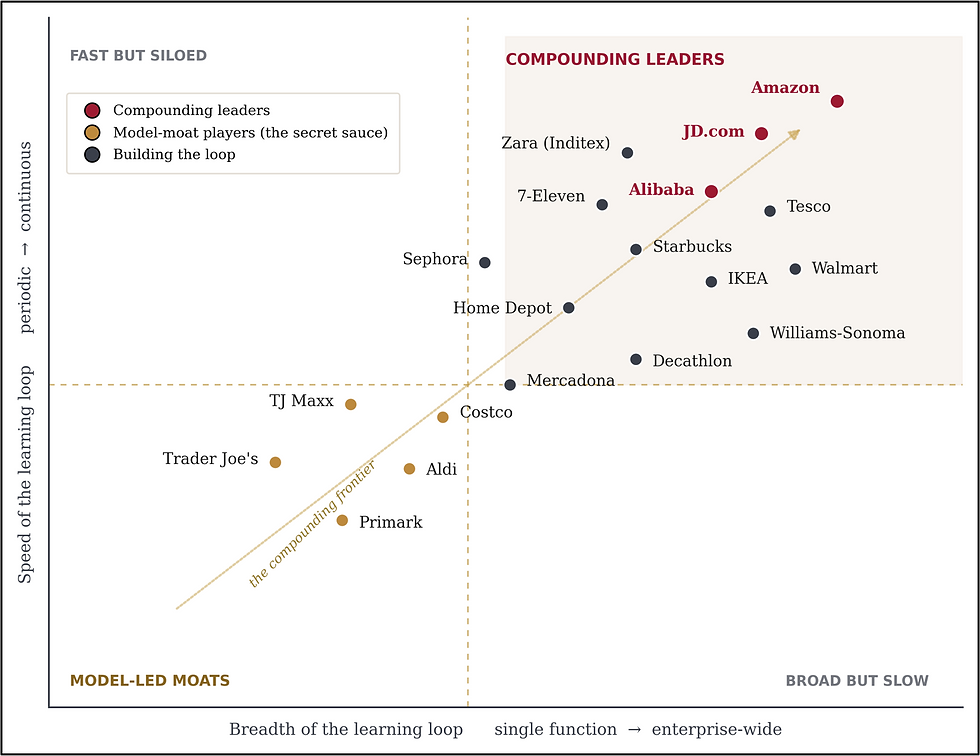
This map is a reasoned synthesis, not a quantitative index. The placements draw on the author’s body of work — more than sixty case studies on leading retailers, sustained analysis of their AI initiatives, and, for many, direct store-level observation. Position reflects the breadth and maturity of each retailer’s learning loop; colour reflects the source of its advantage. Amazon, JD.com, and Alibaba (crimson) anchor the leaders’ quadrant, where intelligence runs continuously across the whole enterprise. The slate dots are building the loop — some fast and tightly integrated (Zara), some concentrated in customer-facing functions (Sephora), some broad and accelerating (Tesco, Walmart, 7-Eleven, Decathlon). The gold cluster (Trader Joe’s, Aldi, TJX, Costco, Primark) sits low on both axes by design: formidable operators whose advantage rests on a hard-to-copy value proposition rather than an AI loop. Readers close to any one company may place it differently; the value is the map, not the precise dot.
But the map carries a warning against reading the new rule too literally. Look at the lower-left and you find some of the most envied operators in retail — Costco, Aldi, Trader Joe’s, TJX, Primark — sitting well below the leaders on both axes and thriving anyway. They are not behind; they have chosen a different moat. Trader Joe’s runs no app, no loyalty program, and no e-commerce, yet generates, by widely cited estimates, roughly $2,000 in sales per square foot, several times the supermarket norm, on the strength of a curated private-label assortment and a cult-like store experience. TJX wins on a treasure hunt that is, by design, almost impossible to replicate online; its edge is a buying organization of some 1,300 merchants and more than 21,000 vendor relationships, not an algorithm. Aldi and Primark win on a value proposition so lean that the loop is almost beside the point.[11] This is the older truth the new rule does not repeal: a sufficiently distinctive secret sauce — a value proposition rivals cannot copy — is itself a durable advantage, and it can hold even as the learning rule rises around it. There is a reason the compounding logic does not run these players down. A learning loop compounds by winning a race everyone is running — better forecasts, sharper pricing, tighter personalization — decisions a rival is also trying to optimize. A secret sauce competes on something rivals structurally cannot replicate at all: Trader Joe’s curation, TJX’s buying network, Costco’s membership economics. Where there is no shared race to run, the loop has nothing to grind against, and the gap never opens.
7 Where the Moat Meets the Loop
It would be a mistake, though, to read the gold cluster as proof that a strong model exempts a company from learning. Their advantage is real, but it is present-tense, not permanent. The moat and the loop are not substitutes; they are layers. A secret sauce decides where a company competes — the ground it has chosen, that rivals cannot easily take. The loop decides how well it keeps winning on that ground. Seen this way, the moat does not free a company from the loop. It tells the company exactly where to aim it.
That correction matters, because the instinct it replaces is the wrong one. The lesson for Costco or TJX is not to do what Amazon does — build sprawling personalization and chase intelligence everywhere. It is the opposite: to point the loop, surgically, at the few operations the moat actually runs on, and make those operations even harder to copy. Applied there, AI does not dilute the secret sauce. It compounds it.
The targets are specific. For TJX, the moat is buying — a treasure hunt assembled by some 1,300 merchants out of thousands of opportunistic lots. That is precisely where machine learning earns its keep: predicting which closeout lots will sell through, at what margin, in which stores, so the buyers’ judgment is amplified rather than replaced. For Costco, the moat is a tightly curated, fast-moving assortment and the discipline behind its pricing; the loop belongs in promotion timing, treasure-hunt item selection, and Kirkland Signature pricing — the levers the membership model actually pulls. Trader Joe’s is the instructive edge case. Part of its moat is deliberately analog: no app, no loyalty data, the human serendipity of the aisle. So its loop belongs in the backroom — assortment, supply, waste — and pointedly not at the customer, where automating the experience would corrode the very thing that makes it singular.
That last case names the real discipline. For a few of these players, part of the advantage is the absence of the loop — the opacity, the restraint, the refusal to optimize the customer into a segment. For them the skill is not adoption but selection: knowing which operations to compound and which to protect from automation altogether. The danger is not only moving too slowly. It is bolting intelligence onto the parts of the business whose magic depends on staying human.
But protect is not the same as ignore, and here the new rule reasserts itself. No moat is permanently immune. The discount that looks unbeatable today is beatable by a rival who forecasts demand a little better; the treasure hunt is sharper in the hands of a buyer whose instincts are amplified by data. Over time, the loop reaches every operation that matters, and the advantage goes to whoever aims it there first. So the honest conclusion is not that every retailer must become a learning machine across the board. It is that every retailer needs a moat — and then must point the loop at the operations that moat depends on, before a rival does. Learning has become the most widely available way to deepen an advantage, not the only way to hold one. The real exposure belongs to the company caught in the middle: no distinctive moat, and no compounding loop with which to build one. For most retailers, who possess no Trader Joe’s-like singularity, the loop is not one option among many. It is the moat still available to them.
8 The Next Frontier: When the Customer Stops Shopping
There is a question about the future of commerce that tends to draw a laugh before it draws silence:
What happens when customers stop shopping?
It sounds absurd — retail exists because customers shop — but it becomes harder to dismiss the longer you sit with it. For decades, strategy has rested on a single assumption: that customers search, compare, evaluate, and choose. Merchandising fights for visibility; marketing shapes consideration; layouts and platforms guide the decision. Success means persuading a person to pick your product, your brand, your store. AI quietly threatens that assumption — and the erosion has already begun. When Netflix proposes a film, Spotify builds a playlist, or Amazon surfaces a product, we are already delegating fragments of choice to machines, mostly without noticing.
Agentic commerce extends that trend to its logical end. Consider something as ordinary as household essentials. Today a consumer makes a list, compares options, checks prices, and places an order — much of it effort rather than value. In an AI-mediated world, an intelligent agent could monitor consumption, anticipate the need, evaluate alternatives across retailers, weigh price and delivery, and execute the purchase. The customer stays in control of intent; the machine absorbs the labor of choosing. And the competitive consequence is profound. Retailers have always competed for human attention. Increasingly they will also compete for algorithmic preference — for the judgment of the agent doing the choosing.
This is no longer hypothetical. Home Depot has begun placing its catalog and its Magic Apron assistant inside third-party AI surfaces — ChatGPT and Google’s AI Mode — so that when a shopper asks an agent how to stop a faucet from leaking, Home Depot’s products and accumulated expertise are what the agent reaches for. Amazon, Walmart, and others are building the buyer’s side of the same transaction, training agents to shop their aisles and, increasingly, anyone’s. The contest for algorithmic preference has quietly begun, and the early movers are the retailers whose loops already make their data clean, their availability reliable, and their information machine-readable.
That changes what wins. The most persuasive campaign no longer guarantees the sale; the strongest underlying value proposition does. Product information, availability, pricing transparency, ratings, fulfillment reliability, and service consistency all gain weight, because they are the inputs an agent evaluates. Note what this does to brand: it makes trust more valuable, not less. When people hand decisions to agents, they will insist those agents act in their interest — and they will route that trust through brands that have earned it. As with every prior technological shift, the deepest disruption will come not because AI changes businesses directly, but because it changes customer behavior first. The question is no longer whether AI will influence shopping. It already does. The more interesting question is what happens when AI begins to do the shopping.
A LEADER’S DIAGNOSTIC
The Rules, Rewritten
If advantage is moving from owning to learning, then the rules every retail leader once internalized are being rewritten one by one. The question each of them raises is what to unlearn. The table below is one answer: seven old rules and the new ones replacing them — less a checklist than a diagnostic for how far an organization has traveled from the logic of assets to the logic of learning.
The Old Rule | The New Rule | What It Demands of Leaders |
Scale | Intelligence | Size still matters, but it now matters chiefly as a multiplier of how well a company learns. Combine both; rely on neither alone. |
Forecasting | Sensing | Stop only predicting demand from history. Detect change as it happens — in search, weather, local events, live behavior. |
Transactions | Relationships | Optimize the lifetime of a customer, not the value of a basket. Every interaction should teach the organization something. |
Automation | Augmentation | Ask less what AI can replace and more what it can elevate. Put intelligence in the hands of people who hold judgment, empathy, and trust. |
Functions | Systems | Intelligence creates the most value where it crosses silos. Let customer signals reach merchandising and supply data reach marketing. |
Experience | Experimentation | Experience still confers judgment, but the half-life of any given answer is shrinking. Build the muscle to test, learn, and refine continuously. |
Managing change | Building adaptability | Change is no longer an event to be managed and finished. The goal is an organization engineered to keep adapting. |
9 Winning in an Intelligent World
Step back from the tools and the trend, and the question leaders are really asking comes into focus:
Ten years from now, what will separate the winners from everyone else?
After decades of watching disruptions arrive, I have come to believe the answer has less to do with technology than most people assume. When e-commerce emerged, many declared the future purely digital. When smartphones reshaped behavior, many forecast the death of the store. When social media remade discovery, some pronounced traditional retail obsolete. In every case the technology mattered — and in every case what actually separated winners from the rest was how effectively leaders adapted their organizations to a changed reality. AI will be no different.
Across the global landscape today, companies are pouring billions into AI — recommendation engines, supply-chain overhauls, generative tools, agents, predictive analytics. Much of it will create value. But technology alone rarely creates lasting advantage; competitors acquire the same tools, and what looks differentiated today becomes standard tomorrow. What stays hard to copy is an organization’s capacity to learn. It is why Amazon, Costco, Zara, Starbucks, Home Depot, and JD.com remain so instructive despite their differences: each has built an organization that listens, observes, experiments, and — above all — converts learning into action faster than its rivals. Over time, that capacity compounds.
So the most important leadership challenge of this era is not technological. It is organizational — and it is human. AI can process information, surface patterns, and sharpen decisions, but leadership remains human, purpose remains human, trust remains human, culture remains human. The organizations that build enduring advantage will be those that fuse machine intelligence with human judgment, and that engineer environments where experimentation is welcomed, information moves freely, and decisions improve with every cycle. Resilience, in an intelligent world, comes not from resisting change but from becoming exceptionally good at navigating it.
After decades of watching these shifts arrive and recede, my own answer is the one this article has been building toward.
The winners will be the companies that never stop learning.
AI will reshape retail. New technologies will arrive, business models will evolve, expectations will keep rising. Beneath all of it, one principle is likely to endure. This is finally what it means to say that AI is redefining the rules of competition. The old rule rewarded ownership — of stores, of scale, of information. The new rule rewards learning, because learning is the one advantage that compounds instead of decaying. AI did not invent that idea; it is what makes the idea decisive, by letting the loop run faster, wider, and cheaper than any organization could before. So the future will not belong to the retailers that simply adopt artificial intelligence. It will belong to those that use intelligence — both human and artificial — to keep reinventing themselves in service of their customers. Scale will still matter. Brands will still matter. Execution will still matter. But the defining advantage of the next era of retail will be the one asset that grows rather than fades with use: the ability to learn faster than everyone else, and to turn that learning into a better decision tomorrow than the one made today.[12]
KEY TAKEAWAYS
The New Rule Advantage no longer flows to whoever owns the most, but to whoever learns fastest. Learning is the one retail asset that appreciates with use, so a learning edge, once opened, compounds into a lead rivals struggle to close. | Where to Aim It Treat AI as a compounding loop, not a catalog of features. Point it first at the unglamorous decisions where retail economics are made — forecasting, inventory, allocation, pricing — and pair it with human judgment rather than replacing it. | On Strong Moats A distinctive value proposition can substitute for breadth today, but no moat is permanently immune. Aim the loop at the operations your moat depends on, protect what must stay human, and avoid the real danger: no moat, and no loop with which to build one. |
References:
[1]The opening anecdote and the executive remark that frames it are drawn from the author’s advisory and executive-education work with retail boards and leadership teams over the past three decades. The quotation is reconstructed from the author’s notes and recollections; identifying details have been withheld by convention.
[2]On organizational learning and dynamic capabilities, see Peter Senge, The Fifth Discipline (1990); David J. Teece, Gary Pisano, and Amy Shuen on dynamic capabilities (1997); and Thomas H. Davenport and Jeanne Harris, Competing on Analytics (2007). The OODA loop is John Boyd’s. The argument here concerns what changes when machine learning removes the human-cognition bottleneck these literatures took as given.
[3]IHL Group, inventory-distortion research, 2025 (reported by Chain Store Age, September 2025). “Inventory distortion” is IHL’s combined measure of out-of-stocks and overstocks; the cited figure is approximately 6.5 percent of global retail sales.
[4]McKinsey & Company, “Succeeding in the AI Supply-Chain Revolution” (2021) and “AI-Driven Operations Forecasting in Data-Light Environments” (2022). These figures describe early adopters and represent directional potential, not guaranteed outcomes; realized gains depend heavily on data quality and execution.
[5]IKEA, “Using AI for smarter demand forecasting” (IKEA Global), and reporting by CX Network (2024), citing Peter Grimvall, IKEA supply-chain development area manager. The demand-sensing tool was piloted in Norway before wider rollout.
[6]IHL Group, inventory-distortion research, 2025 (reported by Chain Store Age). The comparison is between retailers actively deploying AI and machine learning in inventory and forecasting and their slower-moving peers, and is associational rather than strictly causal.
[7]Laura Alber and Sameer Hassan, quoted in Diginomica, “How retailer Williams-Sonoma approaches AI as an amplifier” (August 2025). Williams-Sonoma, Inc. operates Williams Sonoma, Pottery Barn, and West Elm, among other brands.
[8]The Home Depot corporate communications (2025) and Chain Store Age. Sidekick runs on the company’s hdPhones, of which more than 99,000 have been deployed across U.S. stores; Magic Apron, launched in March 2025, is grounded in a proprietary home-improvement knowledge base the company describes as roughly fifteen petabytes.
[9]Figures on Sephora Virtual Artist (developed with ModiFace) as reported by Digital Commerce 360 and Harvard Business School’s Digital Initiative; Color IQ was launched in partnership with Pantone. Engagement figures are as reported and not independently audited here.
[10]Deep Brew launched in 2019 on Microsoft Azure; characterization drawn from Starbucks communications and contemporaneous reporting, including remarks attributed to former CTO Gerri Martin-Flickinger. In 2025 Starbucks withdrew a separate AI shelf-counting tool after accuracy problems.
[11]On the model-moat players: Trader Joe’s sales-per-square-foot and its no-app/no-loyalty/no-e-commerce stance are widely reported (e.g., IMD case study; trade press, 2025–26). TJX’s buying organization (roughly 1,300 buyers and 21,000-plus vendors) and treasure-hunt model are described in TJX corporate materials and analyst coverage (Morningstar, 2024). Aldi and Primark figures reflect widely reported value-model characteristics.
[12]Company examples — among them Amazon, Walmart, Costco, Zara (Inditex), JD.com, Alibaba, Coupang, Mercadona, Home Depot, IKEA, Williams-Sonoma, Sephora, Tesco, 7-Eleven, Decathlon, Trader Joe’s, TJX, Aldi, Primark, and Starbucks — are used illustratively to characterize patterns of competition. They reflect the author’s reading of widely reported strategy and operating models, not proprietary or non-public information, and the matrix positions are the author’s judgment rather than a measured ranking.
Trust us to get your leaders to be at their best!



Comments