
What is Customer Centricity

Everyone talks about it, but very few understand it.
-

-
The Customer-Centric Mirage
Walk into any retail strategy meeting today and you’ll hear the same phrase repeated like a mantra: “We are a customer-centric company.” Executives declare it proudly on investor calls. Marketers print it on slides. Store managers nod in agreement. But scratch beneath the surface and you’ll find a startling truth: most companies have no idea what customer centricity actually means.
For the last ten years, I’ve been teaching customer centricity to MBA students and senior leaders across top global business schools and executive programs. Without fail, I see a pattern repeat itself: shock and disbelief when I reveal that 95% of firms do not understand customer centricity. The fundamental mistake? They treat all customers the same.
The retail industry is more dynamic than ever. US retailers must evolve to succeed in the next decade.- How retailers can keep up with consumers, Mckinsey.com
Even in highly competitive industries like retail, companies spend disproportionate effort trying to lure non-loyal customers through discounts, promotions, and advertising, while completely neglecting their most valuable and loyal base — those who drive the bulk of their profits.
In practice, “customer centricity” has been diluted to mean “we try to please everyone,” “we focus on customer service,” or worse, “we give big discounts”. But real customer centricity, as defined by thinkers like Peter Fader, V. Kumar, and Albert Hirschman, is far more demanding—and far more powerful. It means identifying your most valuable customers, understanding their needs and desires deeply, and reshaping your entire marketing mix—product, pricing, promotions, placement, experience, even company culture—around delighting those most valuable customers (MVC). Done well, it drives word-of-mouth, loyalty, and disproportionate growth. Done poorly—or misunderstood—it becomes a costly race to the bottom.
“Customer-centricity means listening to what shoppers need and designing every part of the business—stores, online, and supply chain—around delivering value and convenience.”- Doug McMillon, CEO-Walmart
Consider grocery retail. Almost every supermarket proudly offers “express checkout” lanes for shoppers with fewer than 10 items. But have you ever seen a fast lane for high-value customers spending $500 on a full cart? Those are the customers contributing the bulk of profits, yet they’re often left standing in line—sometimes long enough to abandon their carts altogether. Stores optimize for the wrong segment, confusing convenience for loyalty.
Another example comes from my work with Vodafone India. While consulting with their senior team across all 20 circles during 2012–13, I found that 95% of their customers were prepaid, yet nearly all of the marketing budget—running into billions of dollars—was spent on converting them to postpaid. Why? Because global playbooks celebrated postpaid as the “loyal” customer base. The reality was the opposite: prepaid users spending ₹5,000 a month provided more value than postpaid customers spending ₹500—and they delivered upfront working capital. Yet they were ignored. Ironically, telecom firms in India are still chasing this mirage, obsessed with converting prepaid into postpaid customers. This misallocation reflects the broader mirage of customer centricity: companies convince themselves they are customer-focused by following industry playbooks, when in reality they are blind to the customers who truly matter.
Why 90% of Retailers Got It Wrong
Walk into any boardroom today and you’ll hear the phrase “customer centricity” repeated with conviction. Executives proclaim it as their North Star, a guiding philosophy shaping everything from strategy to store design. Yet scratch beneath the surface, and a different reality emerges. Despite the rhetoric, nearly 90% of retailers still operate with playbooks better suited to the last century than the one their customers live in today.

The issue isn’t a lack of data, technology, or ambition. Retailers have more dashboards, algorithms, and personalization engines than ever before. The real problem is mindset. Too many companies remain anchored to outdated ways of thinking that don’t fit today’s rapidly shifting retail landscape. And until those mental models are challenged, even the most sophisticated tools won’t make them customer-centric.
Three blind spots, in particular, explain why so many retailers get it wrong:
1. Treating all customers the same.
2. The Illusion of Loyalty
3. Staying product-centric at heart.
Together, these blind spots reveal why “customer centricity” has become more of a corporate slogan than a lived reality in the retail world.
Blind Spot 1: Treating All Customers the Same
In his famous book, Animal Farm, George Orwell said, “All animals are equal but some are more equal than others.” The same is true for customers.
For over a decade, I’ve taught customer centricity to senior executives and MBA students across top global business schools. Without fail, the same scene plays out. When I reveal that 95% of firms treat all customers the same, there’s disbelief. When I show them that 20% of customers drive 70–80% of sales and 80–90% of gross profits, there’s shock. Executives protest: That can’t be true in my industry. Then I ask them to analyze their own data. Slowly, the realization dawns: not only is it true, but they are wasting millions in promotions on the wrong customers, while underinvesting in their most valuable ones.
The next reaction is fear. Leaders worry that if they stop showering discounts on the bottom 80% of customers, they’ll lose them. The truth is the opposite. By disproportionately investing in the most valuable 20%, companies create a loyalty flywheel: delighted customers stay longer, spend more, and—most importantly—attract others like them. Growth compounds.
As Wharton professor Peter Fader argues, “Not all customers are created equal.” Traditional marketing is built around the product: design something great, then push it to everyone. Customer centricity flips the script: identify your most valuable customers and build the business around them. This isn’t about being nice to everyone; it’s about being strategic.
Trying to “wow” the wrong customers—those who buy only on discounts, churn quickly, or return items excessively—destroys value. Focusing on the right ones unlocks it.
Amazon embodies this logic. Prime members spend more than twice as much as non-Prime shoppers. Every feature of Prime—free shipping, streaming, exclusive deals—is designed to deepen engagement with high-value customers, not chase one-time bargain hunters. Costco takes a different but equally focused approach: its membership structure acts as a filter, ensuring only committed, high-value shoppers enter the ecosystem. Executive Members—its most profitable tier—renew at rates above 90%. Neither company relies on gimmicks; both succeed by clearly defining who their best customers are and serving them better than anyone else.
- Angels and Devils: The Best Buy Lesson
Few retailers illustrate this shift better than Best Buy. For years, the company treated all customers equally, offering the same promotions across the board. The result was a flood of “devils”: deal-hunters who exploited discounts, returned items excessively, and eroded margins. Meanwhile, its most valuable customers—its “angels”—went unrecognized.
Best Buy believed that would be better off if it could focus on the most profitable segments and deter unprofitable shoppers. Brad Anderson, CEO- Best Buy, 2005
Former CEO Brad Anderson broke the cycle. Inspired by customer-centric thinking, he led Best Buy to segment its base and tailor experiences to high-value groups, such as small business owners and tech enthusiasts. Stores were redesigned, services expanded, and promotions targeted. The turnaround was striking: profits rebounded, customer satisfaction rose, and Best Buy regained relevance. The lesson was clear: investing in angels while limiting the impact of devils can transform both financial performance and customer experience.
Across industries, the pattern is the same: 20% of customers drive the majority of profits, while many others are margin-negative. Yet most strategies still spread resources evenly. The outcome is predictable: your best customers feel underappreciated, while your least valuable ones are overindulged.
Customer centricity demands the opposite. Not more customers. Not more discounts. But more value, more often, from the right customers.
Blind Spot 2: The Illusion of Loyalty
Customer loyalty is not about frequency alone; it’s about profitability, engagement, and the quality of the relationship.” – V. Kumar, Professor, Goodman School of Business, Brock University
For decades, most retailers have operated with a simple, democratic premise: treat all customers equally. Promotions are broad-based, loyalty programs are one-size-fits-all, and service standards are uniform across the board. On the surface, it feels fair. In practice, it’s financially disastrous. Most loyalty programs are reduced to data collection, and customers are confused as they do not understand what these points mean. There is no stickiness in such same for all- point collection loyalty programs.
Yet most retailers still cling to loyalty programs that do little to build real loyalty. As marketing scholar V. Kumar has shown, these programs typically reward frequency rather than value—encouraging exactly the wrong behavior: price-sensitive shopping from low-value customers.
It feels “fair” to treat all customers equally. It scales easily across systems and resonates with the democratic ethos of retail. But the consequences are devastating: margin dilution, loyalty fatigue, and commoditization. When everyone gets a 20% off coupon, it stops being special. When every shopper receives the same service, your best customers feel ignored. In trying to please everyone, retailers often lose the ones who matter most—the customers who would have gladly paid more and stayed longer if they felt recognized.
By contrast, most retailers cling to loyalty programs that reward frequency rather than value. As marketing scholar V. Kumar has shown, these schemes encourage the very behavior that destroys margin: discount-driven shopping from low-value customers. When everyone gets the same 20% coupon, it stops being special. When every shopper receives identical service, your best customers feel ignored. In trying to please everyone, retailers often lose the ones who matter most—the customers who would have gladly paid more and stayed longer if they felt recognized.
- Trader Joe’s: Loyalty Without Points
Trader Joe’s proves that customer centricity doesn’t require elaborate data systems or points-based programs. Instead, it starts with clarity about who the right customer is. Trader Joe’s core shopper is urban, educated, health-conscious, and value-driven. Every decision—curated private-label products, quirky packaging, intimate store layouts, and famously friendly employees—reinforces this identity.
“Customer centricity is about making the shopping experience delightful, personal, and surprising. That’s how we turn shoppers into loyal fans.”- Trader Joe’s Spokesperson
Trader Joe’s doesn’t chase everyone. It focuses on delighting its tribe. The payoff is remarkable: fanatical loyalty, word-of-mouth advocacy, and steady growth in one of retail’s toughest markets.
Customer centricity demands the opposite. Not more loyalty programs, but focus on loyal customers- the most valuable 20%, generating 80% of Gross profits, and their needs, wants, and preferences.
Blind Spot 3: Staying Product-Centric Instead of Customer-Centric
For decades, many retailers thrived by putting the product first. Mass inventory, endless SKUs, and broad distribution were seen as the path to growth. On the surface, it felt logical: sell more products to more people, and success would follow. In practice, it created a fragile model, dependent on volume rather than loyalty.
When I teach customer centricity, executives often do not realize the difference immediately. A product-centric mindset focuses on “What else can we sell?” instead of “Who are our most valuable customers, and what do they truly need?” As Wharton professor Peter Fader reminds us, customer centricity is about identifying your most valuable segments, understanding them deeply, and shaping your products, pricing, promotions, and experiences to maximize their lifetime value.
90% of companies on planet still operates this way (product centric). 100% of business school teach this way. Because it is simple.- Peter Fader, Professor at Wharton Business School
The product-centric retailers organize themselves around the product. Their mission is to push more units to as many people as possible. For decades, that formula worked. Picture a Saturday morning shopper walking into Sears in the 1990s. The store was stacked high with washing machines, winter coats, and power drills — a one-stop shop for “everything under one roof.” But the interaction was transactional. No one knew her preferences, her past purchases, or why she had come. Sears wasn’t in the relationship business. It was in the inventory-moving business.
Fast forward to today, and Sears is a shell of its former self. Scale, once its strength, became irrelevant when consumers could find better options, faster, online.
Gap faced a similar trap. For years, its product-centric model relied on blanketing the market with accessible basics. But as fast-fashion competitors like Zara and H&M tailored collections to style-conscious shoppers, Gap’s “for everyone” positioning faded. The brand tried to win with more SKUs and more stores. Instead, it lost relevance with its core customer — and profitability with it.
Chains like JCPenney, Sears, and Gap became household names by flooding the market with mass inventory. Success was measured in square footage, store count, and distribution reach.But when consumer expectations shifted — and digital channels gave shoppers infinite choice and transparency — the cracks began to show. These once-dominant giants were selling more products, but to fewer loyal customers. Their shelves were full. Their stores were empty.
By contrast, customer-centric retailers show the power of focus. Now imagine that same shopper walking into Sephora today. Instead of aisles of anonymous inventory, she’s greeted by a Beauty Insider kiosk. With a quick scan, the associate sees her past purchases — the skincare brand she splurges on, the foundation shade she trusts, the lipstick she buys every spring. She’s offered early access to a new serum from her favorite brand and invited to an exclusive beauty masterclass. The message is clear: we know you, we value you, and we’ve designed this experience just for you.
Even at the value end of the spectrum, customer centricity shines. Aldi, for instance, thrives not by selling “everything to everyone” but by curating a lean assortment — roughly 1,600 SKUs compared to a typical supermarket’s 30,000. Its efficiency is laser-focused on value-driven shoppers who prize quality at low cost. Aldi doesn’t try to win gourmet foodies or luxury seekers. It delights its chosen base with ruthless clarity.
Every decision we make—from product assortment to store layout—is guided by one question: what makes life easier and better for our customers?”- Aldi Executive
IKEA offers another twist. Its product range is vast, but its strategy is customer-centric at its core: serving young families and first-time homeowners who want stylish design at an affordable price. Every detail — from the maze-like showroom that sparks discovery, to the in-store childcare that eases stress, to the cafeteria meals priced for value-conscious families — reinforces this focus. IKEA isn’t just selling furniture. It’s designing a whole ecosystem for a specific customer journey.
We work hard to create a better everyday life for our customers. Understanding what they want, even before they do, is at the heart of everything we do.”- Ingvar Kamprad, Founder IKEA
At the value end, Aldi curates a lean assortment of roughly 1,600 SKUs, deliberately serving a defined, value-driven shopper base. IKEA blends breadth with focus, designing its store layout, in-store childcare, cafeteria, and showroom experience around young families and first-time homeowners. Every touchpoint reinforces customer-centric thinking.
Across these examples, the lesson is clear: product-centric retailers define success by volume sold. Customer-centric retailers define success by who they serve and how often those customers return. JCPenney, Sears, and Gap tried to be everything for everyone—and ended up resonating with almost no one. Sephora, Nordstrom, Aldi, and IKEA thrived because they knew exactly whom they served and built their business around those customers.
Customer centricity demands focus, not just inventory. Not more products. Not more customers. But more value, more often, for the right customers.
What Is Customer Centricity?
True customer centricity is far more than a buzzword—it is a discipline, a strategy, and a mindset. At its heart, it asks one question: Which customers truly drive value for your business, and how can you serve them better than anyone else? While the concept may sound straightforward, most retailers get it wrong, defaulting to product-centric strategies that prioritize volume over value. To understand the essence of customer centricity, based on my research and teaching over last tenyears and learning from top retailers, three frameworks provide clarity: Peter Fader’s focus on high-value customers, V. Kumar’s loyalty segmentation, and Albert Hirschman’s Exit, Voice, and Loyalty model.

1. Peter Fader: Not All Customers Are Created Equal
Wharton professor Peter Fader has long argued that businesses fail when they treat all customers alike. In his landmark book Customer Centricity: Focus on the Right Customers for Strategic Advantage, Fader flips traditional marketing on its head: instead of designing a great product and selling it to everyone, companies should identify their most valuable customers and build their entire business around them. Central to this approach is Customer Lifetime Value (CLV), the projected revenue a customer generates over their relationship with the company. A small fraction of customers—often 20%—can drive 80% of profits, while overinvesting in the remaining 80% can erode value.
A customer acquisition strategy that ignores differences in customers’ lifetime value is naïve and inferior.- Peter Fader, Professor, Wharton Business School

Costco is another masterclass in selective intimacy. The store is warehouse-plain. The merchandising is limited. The brands are unflashy. But for members—especially executive tier ones—Costco is a temple of trust. Low prices, high quality, and a “we’ve-got-your-back” return policy. And that trust drives renewal rates north of 90%. Costco doesn’t chase walk-ins. It builds its business around a well-defined core of loyalists who come back with a cart—and leave with a full trunk.
Some of their customer base is absolutely addicted to Costco — absolutely addicted to the experience and the brands and the thrill of going to Costco,” - Patricia Hong, Partner, A.T. Kearney.
Conversely, companies that ignore this insight falter. Sears filled stores with mass inventory but failed to distinguish its high-value shoppers from occasional bargain hunters, ultimately losing relevance. Similarly, JCPenney under Ron Johnson attempted to appeal to everyone with “everyday low pricing,” alienating core coupon-loving customers and triggering a mass exodus.
2. V. Kumar: Loyalty Is Not What You Think
Not all loyal customers are profitable. True customer loyalty comes from those who generate long-term value, not just repeat transactions.” – V. Kumar, Professor at Goodman School of Business, Brock University
If Fader tells us who matters, V. Kumar, Regents’ Professor at Brock University, explains which loyalty counts. His Loyalty Segmentation Matrix classifies customers into four types:
1. True Loyalists – High loyalty, high profitability. These are the core customers.
2. Spurious Loyalists – High loyalty, low profitability. They shop often but contribute little to the bottom line.
3. Butterflies – High profitability, low loyalty. Big spenders who rarely return.
4. Strangers – Low loyalty, low profitability. Minimal value.
Many retailers fall into the trap of rewarding frequency or friendliness rather than profitability. Best Buy, under CEO Hubert Joly, used this matrix to identify “angel” customers—high-margin, loyal buyers—and focus service on them, while limiting costly incentives to “devil” customers who showroomed and eroded margins. Sephora aligns perfectly with Kumar’s framework: top-tier “Rouge” members receive exclusive events and early access because they drive high-margin repeat sales, while occasional shoppers receive standard treatment.
Failure stories also illustrate the peril of ignoring this framework. RadioShack in its final years chased frequent buyers (Spurious Loyalists) with promotions, yet these customers contributed little to long-term profitability. Likewise, JCPenney misaligned rewards, neglecting True Loyalists and courting Butterflies, resulting in a collapse in sales and loyalty.
3. Albert Hirschman: Exit, Voice, and Loyalty
“Companies often overlook the insights of their loyal customers, yet it is precisely this feedback that proves most valuable in nurturing and expanding enduring relationships.” – Albert Hirschman
While Fader and Kumar show whom to serve, Albert Hirschman, prominent 20th-century German-American economist, explains what happens when customers aren’t served well. His classic Exit, Voice, and Loyalty framework posits that dissatisfied customers can:
· Exit – Leave silently for competitors.
· Voice – Complain, give feedback, or advocate for change.
· Loyalty – Stay despite temporary dissatisfaction.
Customer-centric companies cultivate voice and loyalty among their most valuable segments. Trader Joe’s exemplifies this by listening to customer feedback in real time at the store level, allowing popular products like Everything But the Bagel seasoning and Cookie Butter to emerge. In contrast, JCPenney’s coupon-free “everyday low pricing” strategy ignored the voice of its core, prompting an exodus that cost the company $4 billion in sales. Costco demonstrates loyalty’s moderating effect: members tolerate minor stockouts because long-term value and trust outweigh temporary inconvenience.
- Bringing It All Together
Fader shows who to prioritize, Kumar clarifies which loyalty truly matters, and Hirschman reveals how customers react when neglected. Together, these frameworks form a comprehensive playbook: invest in the high-value 20%, understand the types of loyalty that matter, and create mechanisms for feedback before dissatisfaction triggers exit.
At its core, customer centricity is about identifying those 20% most valuable customers and “wowing” them. Align the marketing mix—product, price, promotions, shopping experience, and customer service—to delight these customers. When executed effectively, this not only maximizes their lifetime value but also generates positive word-of-mouth, attracting more high-value customers. The result is exponential growth in sales and profitability, turning customer-centric companies into resilient, thriving businesses that succeed where product-centric competitors falter.

Customer centricity is identifying your top 20% most valuable customers and wowing them—aligning product, price, promotions, experience, and service—to turn loyalty into advocacy, driving exponential growth in sales and profitability.”
Transforming an Idea into Practice: How Customer-Centricity Revived Emax
For years, I taught that customer centricity isn’t a slogan—it’s a discipline grounded in research and proven frameworks. Peter Fader’s Customer Lifetime Value, V. Kumar’s Loyalty Segmentation, and Albert Hirschman’s Exit-Voice-Loyalty model each offer a distinct lens for understanding customers. Together, they provide a powerful compass for creating a truly customer-centric organization.
Then came the ultimate test. In 2015, I returned to the corporate world as CEO, tasked with turning around Emax, a decade-long loss-making consumer electronics retailer in the Middle East. The board was clear: improve results in six months, or the company would be sold or closed. This was survival—a challenge of a lifetime. Emax had been bleeding, squeezed between Amazon’s online convenience and aggressive discounters like Sharaf DG, Jumbo, and Carrefour. Prime mall locations generated foot traffic, but profits were elusive. The company was a textbook case of product-centric retailing—focused on moving units through discounts without understanding customer value.
Turning around Emax was not about fixing numbers; it was about changing mindsets. For nearly ten years, the company was loss-making, with demotivated frontline teams and a culture where many had simply given up. The breakthrough came when we applied the principles of customer centricity in practice, starting with the people who mattered most: customers and employees. The mandate from the board was clear: restore profitability by fundamentally reorienting the business around the customer. It was baptism by fire; that’s when the three academic frameworks moved from classroom slides to boardroom strategy.
Peter Fader taught us that not all customers are equal. Most retailers chase scale, trying to sell one product to millions. Fader flips that model—profitability comes from identifying and over-serving the customers who truly matter. At Emax, this insight was revelatory. For years, blanket discounts treated bargain hunters the same as high-value gadget enthusiasts. Our CRM system revealed that fewer than 20% of customers generated the majority of profits. These were repeat buyers of premium smartphones, appliances, and accessories—previously overlooked while chasing low-margin deal seekers.
The first bold move was to reimagine how customers experienced Emax. Based on data analysis, we discovered that customers spending more than 2,000 UAE Dirham ($600) accounted for more than 70% of revenue and 90% of gross profits. We focused on these most valuable customers by making them VIPs and providing all of them a loyalty card—VIP Club. Based on the data, we further investigated their pain points, shopping habits, and visit frequency, devising a program that combined tangible benefits—exclusive discounts, early access to new launches—with intangible delights like personal greetings and in-store clapping to make them feel like celebrities.
Whenever a customer spent more than 2,000 dirhams, the entire store staff stopped, gathered, and applauded. A red carpet was rolled out, the store manager greeted them personally, photos were taken, and the customer was celebrated like a celebrity. This was not about discounts or transactions; it was about emotions, recognition, and making customers feel truly special. That single act transformed store energy: employees took pride in creating joy, and customers began to associate Emax with extraordinary experiences. To further motivate employees, we launched an instant incentive program for those who converted customers into VIPs by driving single-invoice purchases over 2,000 dirhams. Bonuses were deposited the next day—an unprecedented recognition that turned previously disengaged staff into champions for our most valuable customers.
Building on this, we introduced loyalty tiers that redefined retail relationships. Customers spending more than 5,000 dirhams per transaction became “VVIPs,” and those spending over 100,000 dirhams annually were inducted into the exclusive “Chairman’s Club.” These weren’t just labels. Members enjoyed privileges like same-day or three-hour delivery, dedicated personal shoppers, access to private in-store lounges with local coffee and dates, and surprise visits from managers and CXOs at their homes. Instant after-sales guarantees ensured any issues were resolved within an hour, with replacement “donor” appliances provided as needed. These measures signaled respect and transformed high-value buyers into lifelong advocates.
Fader identified who mattered; Kumar helped us understand why some loyal customers were not profitable. Emax had long rewarded Spurious Loyalists—frequent shoppers chasing discounts on low-margin items—while neglecting Butterflies, profitable but infrequent premium buyers. We flipped the model. Marketing budgets were shifted toward cultivating True Loyalists and Butterflies. Premium smartphone buyers received curated bundles, and loyalty rewards were designed to privilege profitability over frequency. Repeat purchase rates among high-value segments rose 20%, and the average invoice size in priority segments surged as customers began to view Emax as their trusted partner for every major electronics purchase.
Hirschman’s Exit-Voice-Loyalty framework reminded us that profitability is not just about segmentation—it’s about listening. Dissatisfied customers either exit, voice complaints, or stay loyal despite imperfections. At Emax, exit had already occurred; market share had leaked to Amazon and Sharaf DG. But remaining customers provided valuable “voice”: complaints about after-sales service, store navigation, and lack of expert guidance. We captured and acted on these signals: proactive installation support for appliance buyers, digital escalation channels for loyalty members, and retraining store staff to act as advisors rather than transaction-pushers. For the top 20% of customers, we introduced instant service guarantees, donor equipment for repairs, and direct escalation to leadership. Listening converted fragile loyalty into enduring trust.
What emerged was a powerful flywheel effect. Roughly 20% of customers, who accounted for 80% of value, became the centerpiece of our strategy. Tangible benefits and emotional experiences sparked immense word-of-mouth among the region’s wealthiest consumers. They flocked to Emax—not because of pricing, but because of how they were treated. The sight of 100 store associates clapping, leadership showing up at homes, and instant service created a bond no competitor could match.
The results were dramatic: loss-making promotions were reduced by 40%, CLV became the north-star metric, repeat purchase rates in priority segments grew 22%, same-store sales rose double digits despite closing underperforming stores, and Emax returned to profitability for the first time in a decade. Perhaps most importantly, the cultural transformation was profound. Employees who had once been disengaged now celebrated VIP customers. Leadership modeled customer-centric behaviors, visiting homes and ensuring satisfaction. Within six months, Emax had gone from a sinking ship to one of the UAE’s top 25 “Great Places to Work.” Today, Emax continues to be profitable—a remarkable turnaround once deemed impossible.
Turning around Emax was not just about fixing numbers; it was about changing mindsets. Customer centricity reshaped the company culture, energized employees, and rewrote the narrative: from ten years of losses to a market leader synonymous with premium service, loyalty, and pride. As customers now say, “Think electronics, think Emax.”
For four years prior, I had taught these frameworks to MBA students and executives, showing that theory could guide practice. At Emax, we proved it: Peter Fader, V. Kumar, and Albert Hirschman’s principles were not just frameworks in theory—they were a blueprint for tangible business transformation. When applied with rigor, creativity, and an unwavering focus on the right customers, customer centricity can not only restore profitability but also create a culture where employees and customers alike thrive. Customer-centric journeys are enriching and rewarding for business leaders, as immediately after the turnaround of Emax, I was made the Group CEO Retail for Landmark Group, a coveted position, to spread customer centricity across the group in all the countries we operated.
The Roadmap towards Customer Centricity
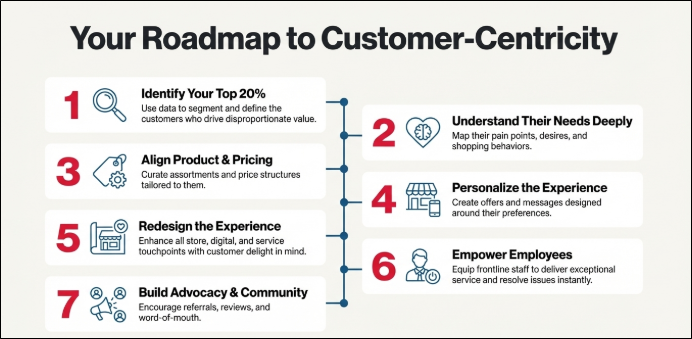
Customer centricity is about identifying your top 20% most valuable customers and wowing them—aligning product, price, promotions, experience, and service—to turn loyalty into advocacy and drive exponential growth in sales and profitability. Leading retailers demonstrate how this principle transforms ordinary shoppers into devoted brand fanatics. Drawing on research, teaching, and hands-on experience, we have developed a seven-step process to help retailers build true customer centricity.
Step 1: Identify Your Most Valuable Customers- The first step is to recognize which customers actually drive your profitability. At Amazon, for instance, a small percentage of Prime members account for a disproportionately large share of revenue and repeat purchases. By analyzing purchase frequency, basket size, and category breadth, Amazon identifies its top-tier customers and prioritizes them for personalized offers, early access to deals, and enhanced service, ensuring that investment is focused where it counts most.
Step 2: Align Product and Service to Their Needs- Once identified, the next step is tailoring products and services to match these customers’ expectations. IKEA, for example, curates offerings and modular solutions for urban young professionals who value space-saving, affordable design. By designing stores, products, and services around their core segment, IKEA turns routine furniture shopping into a seamless, highly relevant experience, reinforcing loyalty and repeat purchases.
Step 3: Price Strategically, Not Uniformly- Pricing should reward value, not just volume. Decathlon excels here by offering high-quality sports equipment at affordable prices, yet providing premium bundles and loyalty benefits for frequent buyers. By differentiating pricing and offers for its core enthusiasts, Decathlon encourages larger purchases, repeated engagement, and long-term brand allegiance without alienating casual customers.
Step 4: Personalize Promotions to Create Impact- Promotions should be meaningful, not mass-blasted. Trader Joe’s achieves this through curated weekly specials and localized store experiences that appeal directly to their top customers’ tastes. By knowing what resonates, promotions become conversation starters rather than mere discounts, strengthening emotional attachment and motivating word-of-mouth advocacy.
Step 5: Craft an Exceptional Shopping Experience- The environment in which customers engage matters deeply. Wegmans, for instance, designs stores that feel welcoming and educational—cooking demonstrations, chef advice, and thoughtful product displays. By making shopping enjoyable, intuitive, and even entertaining, they convert casual shoppers into passionate fans who associate the brand with discovery and delight.
Step 6: Elevate Customer Service to Create Advocacy- Customer service should reinforce value and respect. Patagonia exemplifies this with its repair and reuse programs, personalized guidance, and responsive support for top customers. By solving problems quickly, honoring loyalty, and acting in alignment with customer values, they transform satisfaction into advocacy, ensuring that customers not only return but also evangelize the brand.
Step 7: Build Word-of-Mouth and Flywheel Effects- When top customers feel recognized, understood, and rewarded, their loyalty generates exponential impact. Costco and Apple turn customer advocacy into a self-reinforcing cycle: satisfied core customers bring friends, family, and colleagues, amplifying growth without proportional marketing spend. These brands harness the emotional bond between customer and retailer to create a virtuous flywheel of engagement, trust, and profitability.
Conclusion: Customer Centricity- Turning Customers into Fanatics
“We see our customers as invited guests to a party, and we are the hosts. It’s our job every day to make every important aspect of the customer experience a little bit better.”- Jeff Bezos, Amazon
Customer centricity is more than a strategy—it is a mindset and a culture. By identifying the top 20% of customers and aligning every aspect of the business around delighting them, retailers can transform ordinary shoppers into passionate advocates. From Amazon to IKEA, Decathlon, Trader Joe’s, Wegmans, Patagonia, Costco, and Apple, the evidence is clear: extraordinary customer experiences drive extraordinary growth. When loyalty becomes advocacy, word-of-mouth amplifies impact, sales grow, and profitability soars. The lesson is simple but powerful: to create fanatics, focus relentlessly on those who matter most and wow them at every touchpoint.
Customer centricity is not a buzzword or a collection of tactics—it is a disciplined mindset that prioritizes the customers who truly drive value and aligns every part of the business to delight them. Whether through tailored products, thoughtful pricing, personalized promotions, exceptional experiences, or service that turns frustration into loyalty, the principle is unambiguous: focus on the top 20% of customers, wow them, and watch advocacy—and profitability—multiply. Leading retailers demonstrate that when this mindset is embedded in culture and strategy, ordinary transactions evolve into lasting relationships, occasional shoppers become devoted fans, and fleeting loyalty turns into unstoppable growth. Done right, customer centricity is the ultimate flywheel for sustainable success.
Customer centricity isn’t just a strategy—it’s the art of turning your top 20% most valuable customers into fanatics by wowing them.
Trust us to get your leaders to be at their best!


Comments